

6 June 2019
ZVM began testing a snow and swamp-going vehicle with a unique rotary-screw propulsion
ZVM-2901 Screw-Drive Vehicle: A Transport and Technology Platform
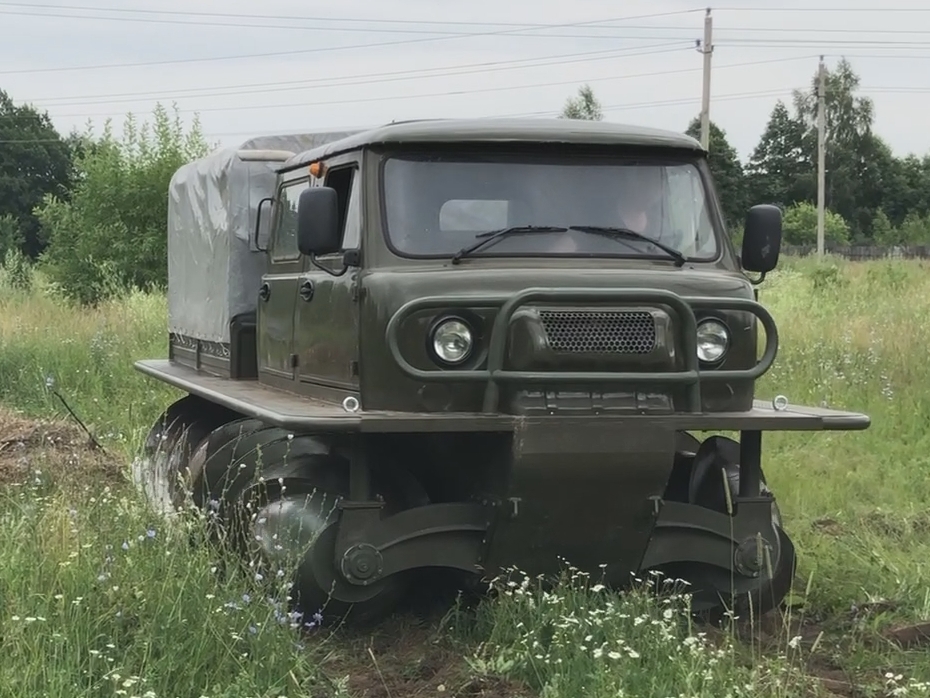 Zavod Vezdekhodnykh Mashin (ZVM — Off-Road Vehicle Plant) has begun testing the ZVM-2901 snow-and-swamp vehicle with a rotary-screw propulsion unit. For ZVM, this marked the development of a separate line of off-road machinery — vehicles capable of operating on swamps, weak-bearing soils, snow, and water areas.
Today, the ZVM-2901 is not just an experimental off-road vehicle with an unusual propulsion system, but a transport and technology platform. It is designed to carry people and cargo, as well as to mount special equipment with which the vehicle can directly perform work tasks.
Contents
- What is a rotary-screw propulsion unit
- Why a screw-drive vehicle was needed at all
- ZVM-2901: from testing to a working machine
- What the ZVM-2901 can carry
- Where such equipment is used
- What makes the ZVM-2901 special
- Why configuration matters
- ZVM as a manufacturer of off-road vehicles
- P.S. From an experimental design to special-purpose equipment
What is a rotary-screw propulsion unit
A rotary-screw propulsion unit, or RSP, is one of the most unusual ways of moving off-road machinery. Instead of wheels or tracks, the vehicle uses two cylindrical rotors with a helical surface. Externally, they resemble large screws or augers — hence the common name for such vehicles: screw-drive vehicle (shnekokhod).
When the rotors rotate, the helical surface interacts with the ground and creates traction. At the same time, the design allows the vehicle to retain the ability to move over weak, waterlogged surfaces and to overcome water areas.
The principle seems unusual, but the engineering logic here is quite clear: if a wheel or track has difficulty finding sufficient grip on the surface, a different type of propulsion unit designed to operate in completely different conditions can be used.
More about screw propulsion units: how screw-driven machines are built, why they are used on swamps and weak soils, and how this principle of movement differs from wheeled and tracked ones — we cover this in a separate article about screw-drive vehicles.
Why a screw-drive vehicle was needed at all
Each type of off-road propulsion has its own area of application. Wheeled vehicles are convenient where high speed is required and there is a relatively firm surface. Tracked vehicles significantly expand off-road capabilities and can operate on soils where wheeled transport is already limited.
However, there are territories where the surface itself becomes the main obstacle: swamps, waterlogged and weak-bearing soils, virgin snow, areas with a large amount of water. Specialized solutions are used for such conditions.
The rotary-screw propulsion unit is interesting because it combines the ability to move over weak soils with buoyancy. Therefore, a route for a screw-drive vehicle can include not only a swampy area or deep snow, but also a water obstacle. It is precisely for such tasks that RSP vehicles are created.
ZVM-2901: from testing to a working machine
For the plant, this was not just work with an unusual design. The task was to create a machine that could be used as a practical tool in hard-to-reach areas.
Today, the ZVM-2901 is positioned as a transport and technology platform with a rotary-screw propulsion unit. This definition is important. The vehicle is intended not only to deliver a person or cargo from point A to point B. Technological equipment can be mounted on the platform, and the off-road vehicle can be used directly to perform work.
ZVM produces not only screw-drive vehicles. The plant's lineup includes wheeled and tracked snow-and-swamp vehicles, as well as machines with various designs and purposes. The choice of a specific type of equipment depends on operating conditions, the route, and the customer's task.
What the ZVM-2901 can carry
The design of the ZVM-2901 allows the vehicle to be used as transport for people and cargo or as a basis for special-purpose machinery. Various technological equipment can be mounted on the platform — for example, a manipulator crane, excavator equipment, a soil pump, and other units. A power take-off shaft is provided to drive the technological equipment.
Thus, the screw-drive vehicle can perform several functions at once:
- deliver specialists to the work site;
- transport cargo and equipment;
- overcome difficult off-road sections;
- operate on swampy and weak-bearing soils;
- overcome water areas;
- be used as a mobile base for special equipment.
This is the core idea of the transport and technology platform: the off-road vehicle becomes not only transport but also a working tool.
Where such equipment is used
The need for screw-drive vehicles arises where delivery by conventional transport becomes difficult or impossible.
Swamps and waterlogged territories
For construction, engineering, land reclamation, and other work, it may be necessary to deliver people, materials, and equipment directly to the site.
Weak-bearing soils
On soils that do not allow conventional machinery to effectively perform transport tasks, specialized off-road solutions are used.
Snow and virgin snow
The rotary-screw propulsion unit allows the ZVM-2901 to be used in snowy areas where special transport is required.
Water areas
The vehicle's buoyancy makes it possible to overcome water obstacles directly along the route.
Hard-to-reach facilities
If a facility is far from roads and people, materials, or equipment need to be delivered to it regularly, the off-road vehicle can be used as an independent means of transport.
What makes the ZVM-2901 special
The main feature of the vehicle is the combination of a rotary-screw propulsion unit and a transport and technology platform. The ZVM-2901 is equipped with two rotors 800 mm in diameter. The vehicle's ground clearance is 250 mm, and the design is intended for operation in conditions for which conventional road transport is not designed.
The vehicle can carry cargo or technological equipment weighing up to 1,500 kg. The maximum permissible gross weight is up to 5,500 kg.
Depending on the configuration, diesel power units are used. One of the provided options is a YaMZ-5344 engine with a power of 99.2 kW (134.9 hp). The maximum speed on ice is stated at up to 25 km/h, and afloat — up to 10 km/h. At the same time, the specific configuration of the vehicle is determined by its purpose and operating conditions.
Why configuration matters
For off-road equipment, you cannot choose a vehicle based on just one parameter — for example, engine power or payload capacity. The entire set of conditions matters:
- what surface the vehicle will need to move over;
- how difficult the terrain is;
- whether there are swampy or water areas;
- what cargo needs to be transported;
- how many people will work on the vehicle;
- what technological equipment will be required;
- whether the equipment will need to be driven from the power take-off shaft.
Therefore, the ZVM-2901 can be viewed precisely as a platform that is adapted to a specific task. For one project, the main requirement will be transporting people and cargo. For another — mounting equipment. In a third case, the combination of payload capacity, buoyancy, and the ability to work on weak-bearing soil is more important.
ZVM as a manufacturer of off-road vehicles
The rotary-screw propulsion unit is only one of the directions in which ZVM develops and manufactures off-road equipment. The plant produces machines for various operating conditions: wheeled, tracked, and rotary-screw snow-and-swamp vehicles.
Therefore, when choosing equipment, it makes sense to start not with the question "which off-road vehicle is the most capable," but with another:
What conditions will need to be overcome, and what work must the vehicle perform?
If transport is needed for swampy terrain and weak soils, a screw-drive vehicle may be suitable. If the route involves other conditions, a wheeled or tracked vehicle may be a more rational solution. That is precisely why ZVM's lineup uses different types of propulsion.
P.S. From an experimental design to special-purpose equipment
The history of the ZVM-2901 began with testing in 2019. Over several years, the task itself became clearer: the rotary-screw propulsion unit is needed not for the sake of an unusual design, but to solve specific transport and technological tasks in difficult conditions.
Today, the ZVM-2901 is a specialized transport and technology platform capable of carrying people, cargo, and equipment across swamps, weak soils, snow, and water areas. At the same time, the screw-drive vehicle is not a universal replacement for wheeled or tracked machines. Its purpose is to work where the advantages of the rotary-screw propulsion unit specifically become in demand. Therefore, the choice of such equipment always begins with the operating conditions.
If you are considering the ZVM-2901 for a specific facility or project, ZVM specialists can select a configuration taking into account the route, cargo, number of people, and the required technological equipment.
More about the ZVM-2901
Current technical specifications, configuration options, and equipment for mounting on the ZVM-2901 platform can be found in the ZVM-2901 model card.
Other ZVM off-road vehicles
If operating conditions differ from the tasks of a screw-drive vehicle, take a look at other ZVM snow-and-swamp vehicles — wheeled, tracked, and other specialized machines.
Discuss Your Task and Choose the Right Equipment
Contact Zavod Vezdekhodnykh Mashin specialists to get a consultation on screw-drive vehicles, discuss purchasing terms, and select a configuration for your project.