

 Russian and foreign tracked all-terrain vehicles: how two-link machines differ, which propulsion systems deliver high cross-country ability, and why when choosing equipment it is important to consider not only payload capacity but also towing capability.
Late November in Russia is the time when winter conditions gradually become a serious challenge for transport equipment. Snow, swampy areas, frozen ground, the absence of roads and the remoteness of sites all require special transport solutions.
For companies in the oil and gas sector, geological exploration, energy, forestry and emergency rescue services, equipment capable of operating where an ordinary car or a wheeled all-terrain vehicle can no longer cope is especially relevant.
One such solution is two-link tracked snow-and-swamp vehicles. They combine high cross-country ability, the ability to move on water, spaciousness and the capacity to carry cargo in conditions of complete off-road terrain.
Such equipment is produced in different countries. Among the well-known foreign representatives are the Swedish Hägglunds BV206 and the modern BAE Systems BvS10 Beowulf. In Russia, this direction is represented by Zavod Vezdekhodnykh Mashin (ZVM) with its family of two-link snow-and-swamp vehicles, the UNZHA.
Let us look at the features of these machines, compare engineering solutions and work out what to pay attention to when choosing equipment for operation in Russian conditions.
Two-link design: what is the main advantage?
The main feature of a two-link snow-and-swamp vehicle is the presence of two independent sections connected by a special articulated joint.
The first section houses the engine, the driver's cabin and the controls. The second section can be used for carrying passengers, cargo or accommodating special equipment.
Both links are driven, meaning they each have their own tracked propulsion.
This design provides a number of advantages:
- high cross-country ability on low-bearing soils;
- load distribution between the two sections;
- the ability to carry a significant number of passengers and cargo;
- improved manoeuvrability on difficult terrain;
- the ability to move on water;
- versatility of application across various industries.
The two-link layout is especially in demand where people, equipment and materials need to be delivered to remote sites without developed road infrastructure.
Foreign experience: Hägglunds BV206 and BvS10 Beowulf
The Swedish engineering school has extensive experience in developing two-link tracked machines.
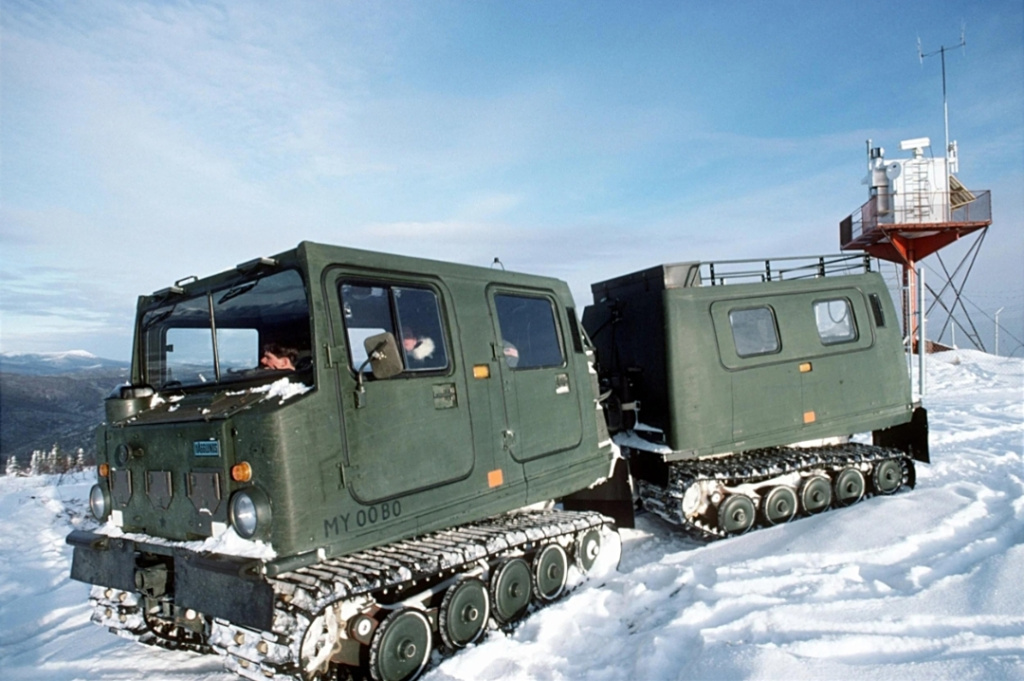
Hägglunds BV206
One of the best-known representatives of this class is the two-link tracked all-terrain vehicle BV206.
The machine features an articulated design, rubber tracks and the ability to travel on water.
According to published technical specifications:
- payload capacity — up to 2,250 kg;
- passenger capacity — up to 16–17 people depending on the version;
- towed trailer mass — up to 2,500 kg;
- average ground pressure on soft surfaces — about 11.6 kPa for the front and 13 kPa for the rear section.
BV206 has become one of the most recognisable representatives of two-link all-terrain equipment and is used in various fields, including rescue and transport tasks.
BAE Systems BvS10 Beowulf
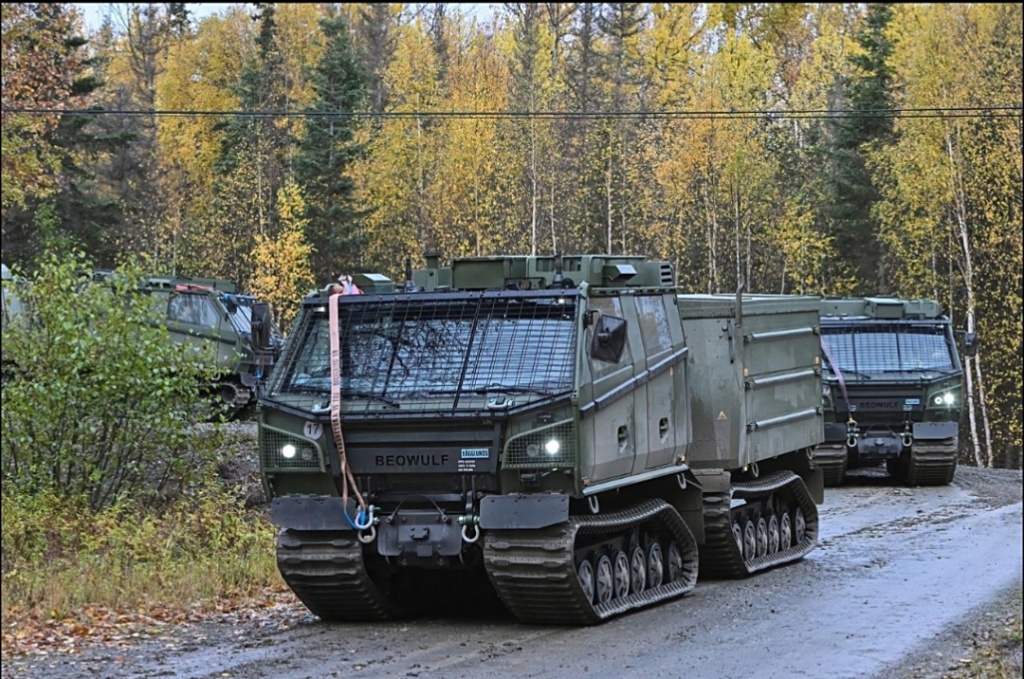
A more modern development of the two-link concept is represented by the BvS10 Beowulf produced by BAE Systems Hägglunds.
This is an amphibious machine with increased payload capacity, designed for operation in challenging climatic and natural conditions.
According to the manufacturer's materials:
- payload capacity of the base platform — up to 8,000 kg;
- capacity — up to 14 people;
- maximum speed — up to 65 km/h;
- the ability to move on water without prior preparation is provided for.
It is important to understand that Beowulf belongs to a heavier class of equipment. Therefore, it is more correct to consider it as an example of the development of two-link tracked platforms rather than as a direct equivalent to Russian machines in all respects.
Russian development: ZVM UNZHA two-link snow-and-swamp vehicles
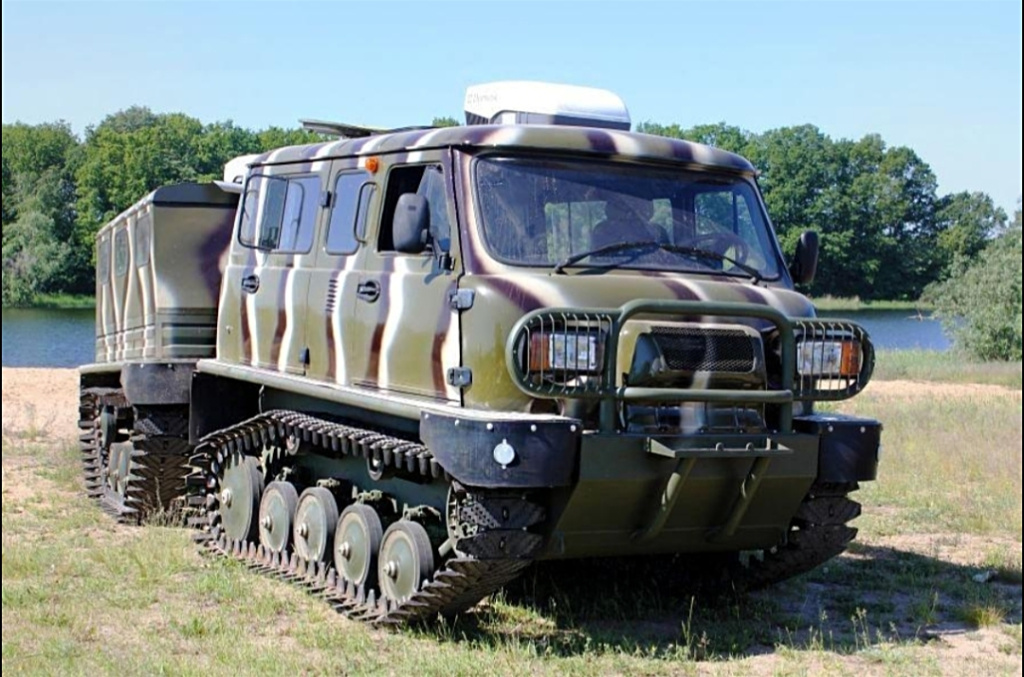
Zavod Vezdekhodnykh Mashin is developing its own line of two-link tracked high-mobility equipment.
The UNZHA family is represented by two main modifications:
- ZVM-3402 — a snow-and-swamp vehicle with link-type tracks;
- ZVM-3402 WT — a snow-and-swamp vehicle with belt-type tracks.
Both machines have a two-link design with two driven propulsion sections.
The first section is intended for the driver and passengers, while the second can be used for carrying passengers or cargo.
Key technical specifications of the family:
- payload capacity — 1,500 kg;
- seating — 5 in the first section and 10 in the second;
- kerb weight — 4,300 kg;
- ground clearance — 400 mm;
- CUMMINS ISF2.8 diesel engine with 110 kW (149.6 hp).
The modifications differ in the design of the tracked propulsion, track gauge and average ground pressure figures.
Link-type and belt-type tracks: two engineering solutions
The type of propulsion is one of the key factors determining the operational characteristics of a tracked snow-and-swamp vehicle.
Two design variants are used in the UNZHA family.
ZVM-3402 — link-type tracks
This modification uses one-piece stamped metal track plates with an open sequential hinge.
This design is a set of individual metal elements connected into a track chain.
Features of the solution:
- metal construction of the track plates;
- sequential hinged connection;
- the ability to adapt to various operating conditions;
- use of various track configuration options.
ZVM-3402 WT — belt-type tracks
The WT modification uses an asphalt-friendly belt-type rubber-cord track with embedded metal links.
The track width is 620 mm.
The main advantage of this solution is the increased contact area with the surface, which allows reducing specific ground pressure.
Average ground pressure:
- ZVM-3402 — 19/21 kPa;
- ZVM-3402 WT — 12/10 kPa.
Thus, the WT demonstrates lower ground pressure and is of particular interest for operation on low-bearing surfaces.
The choice of a specific version depends on the nature of the routes, the type of soil and the operating conditions.
Additional capabilities: UNZHA can tow a trailer of up to 750 kg
An important feature of the UNZHA snow-and-swamp vehicles is the ability to use not only their own cargo and passenger sections but also additional trailed equipment.
The machine is capable of towing a trailer with a mass of up to 750 kg.
This significantly expands the transport capabilities of the all-terrain vehicle.
The trailer can be used for delivering:
- additional equipment;
- tools and materials;
- spare parts;
- cargo for remote production sites;
- special equipment for expedition and emergency rescue operations.
For companies operating in off-road conditions, this capability allows them to build a more flexible transport complex.
In effect, UNZHA can perform several tasks at once: carry people, deliver cargo in its own sections and transport additional equipment on a trailer.
This is especially relevant for geological exploration, the oil and gas industry, forestry and work in remote areas.
Comparison of Russian and foreign snow-and-swamp vehicles
For clarity, let us compare the main characteristics of the ZVM-3402, ZVM-3402 WT and the foreign two-link all-terrain vehicle Hägglunds BV206.
| Parameter | ZVM-3402 | ZVM-3402 WT | Hägglunds BV206 |
|---|---|---|---|
| Design | Two-link | Two-link | Two-link |
| Type of propulsion | Link-type track plates | Belt-type tracks | Rubber tracks |
| Payload capacity, kg | 1,500 | 1,500 | Up to 2,250 |
| Seating | 15 | 15 | Up to 16–17 |
| Ground pressure, kPa | 19/21 | 12/10 | 11.6/13 |
| Trailer towing, kg | Up to 750 | Up to 750 | Up to 2,500 |
Note: the characteristics of the foreign equipment are given according to published data. They may differ depending on the modification and configuration. The trailer towing data for ZVM are given according to the manufacturer's information.
The comparison shows that the same two-link architecture can be implemented with different design solutions.
BV206 has a higher declared payload capacity and permits towing a heavier trailer. The ZVM-3402 WT features lower ground pressure compared to the BV206 figures presented. At the same time, the choice of equipment should be determined not by a single characteristic but by the combination of operational requirements.
How to choose a two-link tracked snow-and-swamp vehicle for Russian conditions?
When choosing equipment for off-road operation, it is important to consider not only the specification figures but also the actual operating conditions.
Type of terrain
For swampy areas and low-bearing soils, ground pressure is of great importance. For virgin snow, cross-country terrain and areas with various obstacles, the design of the propulsion and chassis must be taken into account.
Nature of transportation
If the main task is delivering work crews, passenger capacity matters. If equipment and materials need to be transported, payload capacity and cargo placement options come to the fore.
Additional transport load
When operating at remote sites, the possibility of towing a trailer should be taken into account. This allows the useful transport capabilities of the machine to be expanded without changing its basic design.
Climatic conditions
For year-round operation, the temperature range, engine starting specifics, the availability of heating equipment and maintenance capabilities must be taken into account.
Cost of ownership
The purchase price is only one component of the costs. The availability of spare parts, repairability, service support and the ability to adapt the equipment to specific tasks are also important.
Russian and foreign all-terrain vehicles: what to choose?
There is no universal answer to the question of which machine is better.
The Hägglunds BV206, BvS10 Beowulf and the Russian UNZHA represent different implementations of the two-link tracked concept.
Foreign developments demonstrate extensive experience in creating specialised equipment for difficult natural conditions. Russian ZVM snow-and-swamp vehicles are focused on solving transport tasks with due regard for the requirements of domestic enterprises and operating conditions.
When choosing, it is important to evaluate:
- cross-country ability and ground pressure;
- design of the tracked propulsion;
- payload capacity and spaciousness;
- trailer towing capability;
- maintenance specifics;
- availability of spare parts;
- compliance of the machine with specific production tasks.
The ZVM-3402 and ZVM-3402 WT UNZHA are two versions of a two-link snow-and-swamp vehicle that allow the configuration to be matched to the specific nature of the routes and operating conditions.
The ability to carry people and cargo, move over difficult terrain and tow a trailer of up to 750 kg expands the functionality of this equipment.
More about the ZVM-3402 and ZVM-3402 WT models can be found on the official website of Zavod Vezdekhodnykh Mashin.
ZVM — equipment for working where the roads end.
Sources and technical materials
Official model pages and additional materials used in preparing this comparative review.
ZVM equipment
- Official website of Zavod Vezdekhodnykh Mashin — information on the model range and products.
- ZVM-3402 UNZHA — official information on the two-link snow-and-swamp vehicle.
- ZVM-3402 WT UNZHA — information on the belt-type track modification.
Foreign equivalents
- BAE Systems — information on tracked equipment of the BvS10 family.
- Hägglunds / Bv206 — materials on the Swedish two-link all-terrain platform.
Note: technical characteristics may vary depending on the modification, year of manufacture and configuration. Before using comparative data when choosing equipment, it is recommended to check the current technical documentation of the manufacturers.
Prepared by the Digital Communications Department of LLC "Zavod Vezdekhodnykh Mashin" zvm-nn.ru
For partnership and content usage enquiries: digital@zvm-nn.ru