


Until recently, a trip to Kamchatka seemed like something from the "someday, if I get rich" category. Now things are more interesting. People are going. Not only on expensive tours with helicopters and five-star hotels, but also for fishing, on expeditions, to remote bases, on hikes, to see volcanoes, bears, and simply the edge of the map.
Kamchatka is getting closer. So is Chukotka. Sakhalin, the Kuril Islands, Magadan, Yakutia — all increasingly appear in the travel plans of people who used to choose Turkey, Sochi, or Kaliningrad.
And here a small problem arises. There are more tourists. But for some reason, there are no more roads.
Kamchatka ends where the road ends
This is, of course, an exaggeration. But not such a big one.
You can talk for a long time about the beauty of Kamchatka, but a person who works in tourism there professionally thinks about something a little different. How to get the guests there? How to deliver food and equipment? How to reach the base? What to do if heavy rain has fallen? What if snow has fallen? What if the road has been washed out? What if there is a river ahead that could be crossed yesterday, but not today?
And most importantly — how to make the tourist route not depend entirely on how well the weather turned out this year. Because the nature of Kamchatka does not usually sign off on its plans with the tourism business.
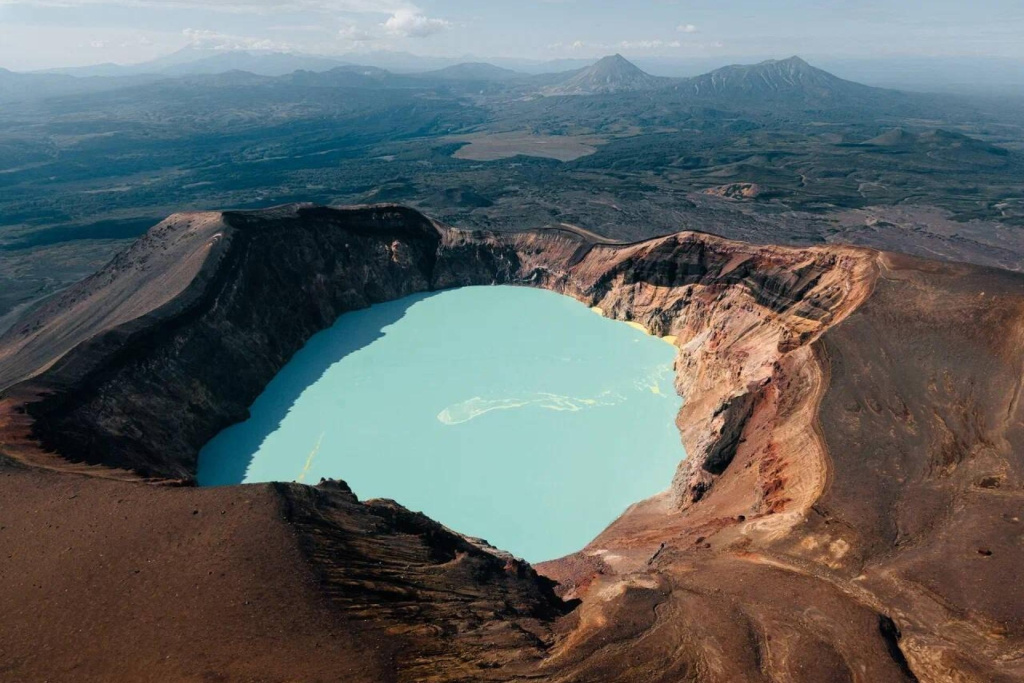
Now let's look at the real Kamchatka
All the talk about the inaccessibility of Kamchatka is not a marketing exaggeration.
It is enough to open an operational bulletin. In early November 2026, routes were closed in four nature parks in Kamchatka — Nalychevo, Klyuchevskoy, South Kamchatka, and Bystrinsky. The road to Avachinsky Pass was washed out after rains, and a ravine formed — movement is complicated and unsafe. On the Palana — airport highway, an undercut was recorded at the bridge over the Palana River, and restoration work is underway. And on the Milkovo — Klyuchi — Ust-Kamchatsk road, traffic restrictions stretched for a hundred kilometers due to emergency restoration work.
By mid-November, all nature parks in Kamchatka were closed until a stable snow cover formed — the off-season, landscape conditions, and minimization of anthropogenic impact. Later, the remaining parks also closed, and winter routes will open only with the arrival of winter. And hydrologists recorded ice phenomena and rising water levels on the region's rivers — in some places slush flows, in others ice jams.
That is, a tourist route in Kamchatka is not always a story about "getting in the car and driving." Today they drove through. Tomorrow it rained — and the river became different. The day after tomorrow the road may become a rut. And then the most interesting part begins: the tourist still wants to get where he bought the tour. And the tour operator still needs to get him there.
That is why Kamchatka is interesting to us. Not as a beautiful point on the map. But as a place where equipment must actually work in real conditions.
Where is the off-road vehicle here?
This is the question we are currently working on at Zavod Vezdekhodnykh Mashin (ZVM). Our production is snow-and-swamp vehicles. Until now, the main conversation about such equipment has been quite familiar: industry, geology, energy, shift transport, rescue services. But we are increasingly looking toward tourism.
Not because we decided to simply find another sales market. But because we are starting to see a fairly obvious thing: in hard-to-reach tourism, transport is part of the tourist product itself.
If a hotel or base is located where an ordinary car can reach with a great many caveats, that is one story. If the operator wants to show guests a place where an ordinary car does not reach at all, that is a completely different one. And if a company independently organizes expeditions, hunting, fishing, transfers, and cargo delivery to remote bases — equipment becomes one of the key elements of the business.
Not "joyrides," but a full-fledged expedition vehicle
That is why we now invite the tourism business to look at VEYA not as an attraction. But as a working unit of its own transport fleet. For transferring guests. For delivering equipment and cargo. For supporting remote bases. For winter and off-season work. For routes where an ordinary SUV is already beginning to yield territory. And, possibly, for creating new routes that were previously simply too difficult to organize.
ZVM currently has a special seasonal offer for tourism companies. The cost of a full-fledged expedition VEYA — from 6.5 million rubles. And this is already serious equipment for serious routes, not a weekend toy.
And it is not limited to Kamchatka
We are looking wider. Kamchatka. Chukotka. Sakhalin. The Kuril Islands. Yakutia. Magadan Region. Everywhere there is different nature, different logistics, and different tourist products. But the problem is often the same: the more interesting the place, the harder it is to get there.

Chukotka. In early November 2026, a powerful cyclone raged here: in Anadyr, wind gusts reached 43 m/s, heavy snow fell, and visibility on the roads was limited. In the middle of the month — a new wave: snowfalls, winds up to 25 m/s in the coastal zone, and frosts down to -35°C in the Bilibinsky District. Winter roads are opening later than usual, and some dirt roads have been washed out by autumn rains. The regional government has signed an agreement with the Tutu service to promote tourist routes, but many sites are still accessible only by prepared equipment.
Sakhalin. New resorts and cable cars are being actively built on the island, but the infrastructure for the "last mile" still remains a headache for operators. In early November 2026, a cyclone with a blizzard and winds up to 30 m/s covered ten districts of the region, and visibility dropped to 500 meters. Tourist groups were advised to wait out the bad weather in shelters — but not every group has time to wait.
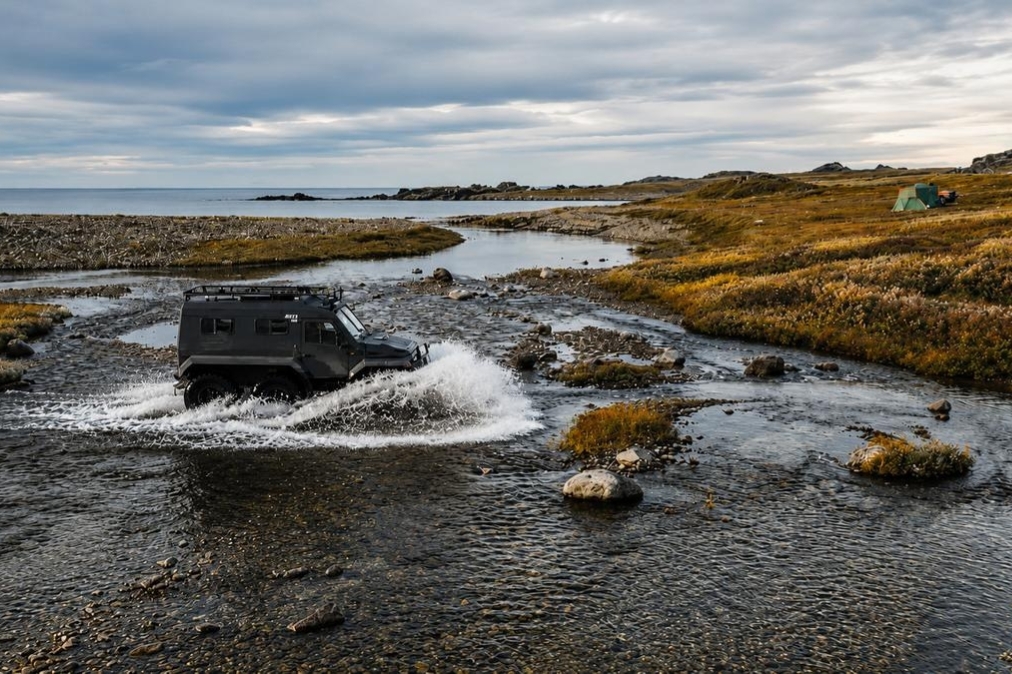
Magadan Region. Hiking trails are being improved in the region, but many of them are still accessible only by prepared equipment. In late October 2026, snow fell on the Kolyma, and some dirt roads turned into directions — ordinary SUVs got stuck within the first kilometers.
The Kurils. Participants in the first surf expedition identified 18 potential surf spots in hard-to-reach coastal areas. This means that interest in the region is growing, and access to these spots without special transport is practically impossible. Plus volcanic activity and frequent cyclones — the weather here can change within a few hours.
Yakutia. In autumn 2026, early snowfalls and sharp temperature swings were recorded in the central and northern uluses of the republic. Winter roads are opening with a delay, and some sections of the routes are being washed out by rains. For tourist groups, this means: without a high-mobility off-road vehicle, the route may simply not take place.
And, perhaps, that is precisely why the Far East is becoming one of the most interesting regions for the development of expedition tourism. The tourist wants to go where there is no crowd. The tour operator wants to take him there. And transport must somehow come to an agreement with nature.
Conclusion
All these conversations about the inaccessibility of Kamchatka, repeated again and again, are not an artistic exaggeration. And, perhaps, this is a good challenge for equipment manufacturers.
Because such a machine wants not only to be shown at an exhibition or photographed against a beautiful backdrop. It wants to be seen where it must actually work. In mud. In snow. On a broken road. By a river after rains.
And, frankly, after such bulletins one wants not so much to watch the VEYA presentation once again, as to come to Kamchatka ourselves and see what is happening there with those rivers. And check out the floods while we're at it. Damn them.
Tourism is developing. Tourists are coming. There are more routes. And nature continues to do whatever it wants. The weather changes. Rivers rise. Routes close. Roads turn into directions. And tourists still want to go.
And this, perhaps, is one of the features of the Far East that cannot be canceled by decree. Therefore, equipment for such regions wants not only to be sold through catalogs. It wants to be seen where it must actually work.
VEYA — wheeled snow-and-swamp vehicles by ZVM
Manufactured by Zavod Vezdekhodnykh Mashin LLC (ZVM), Nizhny Novgorod.
Special seasonal offer for the tourism business:
Kamchatka and Chukotka. In early November, a powerful cyclone raged in northern Kamchatka and the Anadyr District of Chukotka. In the Penzhinsky and Olyutorsky districts, winds reached 25 m/s with a blizzard, which led to the cancellation of local flights. In Anadyr, gusts reached hurricane-force 43 m/s, heavy snow fell, and visibility on the roads was limited. In the middle of the month — a new wave: snowfalls, winds up to 25 m/s in the coastal zone, and frosts down to -35°C in the Bilibinsky District.
Sakhalin and the Kurils. On November 7, a cyclone with a blizzard and winds up to 30 m/s covered ten districts of Sakhalin, and visibility dropped to 500 meters. In the Kurils, waves up to 4 meters were forecast with flooding of low-lying areas, and heavy snow brought up to 17 mm of moisture with winds up to 32 m/s. Precipitation with winds up to 25 m/s persisted for several days — the "window" for dropping off a group could close within a day.
Yakutia and Magadan. In autumn, early snowfalls and sharp temperature swings were recorded, winter roads are opening with a delay, and some routes have been washed out by rains. According to forecasts from the North Eurasian Climate Center, the winter of 2026–2027 in the Far East is expected to be colder than normal — especially in Magadan Region, Chukotka, and Kamchatka.