

The off-road vehicle has long been an integral part of the region's infrastructure.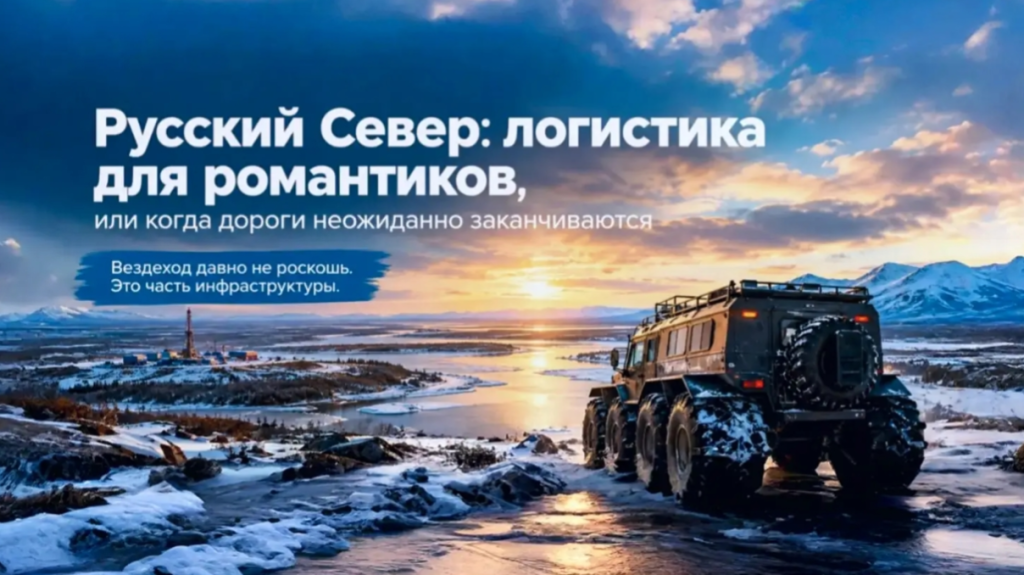
On the map it looks completely ordinary.
But if the first 120 kilometers run along a winter road, then boggy tundra begins, after 40 kilometers you need to cross several channels, and the last 15 kilometers have no road at all — ordinary logistics stops working.
In the North, transport sometimes must not travel along a road, but replace it.
That is why off-road vehicles become part of the transport system of remote territories.
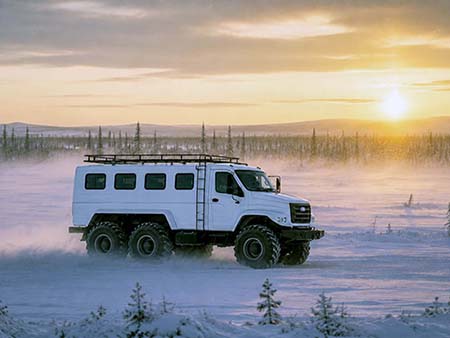
Where the road network ends
Large cargo can reach a northern region by sea, river, railway, or ordinary freight transport.
But then the “last mile” begins.
More precisely, the last tens or hundreds of kilometers.
To a geological camp.
To a drilling rig.
To a power transmission line.
To a weather station.
To a remote production site.
To a settlement.
It is impossible to build a road to every such site.
And it is not always economically reasonable.
Therefore another task arises:
How can a territory be made accessible without building a permanent road?
The answer largely determines the development of modern northern logistics.
An off-road vehicle is not an “improved SUV”
A very common mistake is to perceive a snow-and-swamp vehicle as an ordinary car that was simply given bigger wheels and higher ground clearance.
In reality, the design philosophy is different.
An ordinary car is designed primarily to move over a surface that can already support its mass.
An off-road vehicle is designed taking into account that the surface itself may be weak.
Swamp.
Moss.
Tundra.
Snow.
Peat.
Sand.
Shallow water.
Therefore one of the key parameters is ground pressure.
The larger the area of contact between the machine and the surface, the lower the load on each section of ground.
Hence low-pressure tires, tracks, two-link designs, and other engineering solutions.
Cross-country ability begins not with the engine. It begins with how the machine distributes its own weight.
Why power does not always save you
You can put a very powerful engine in a machine.
But if the wheels sink into weak ground, power becomes a useless characteristic.
The machine may spin its wheels even more intensely.
That is why northern equipment is a constant compromise between:
- weight;
- payload capacity;
- support area;
- ground pressure;
- traction;
- speed;
- autonomy.
That is why there is no single “best” machine for all conditions.
There is a machine that is optimal for a specific route and a specific task.
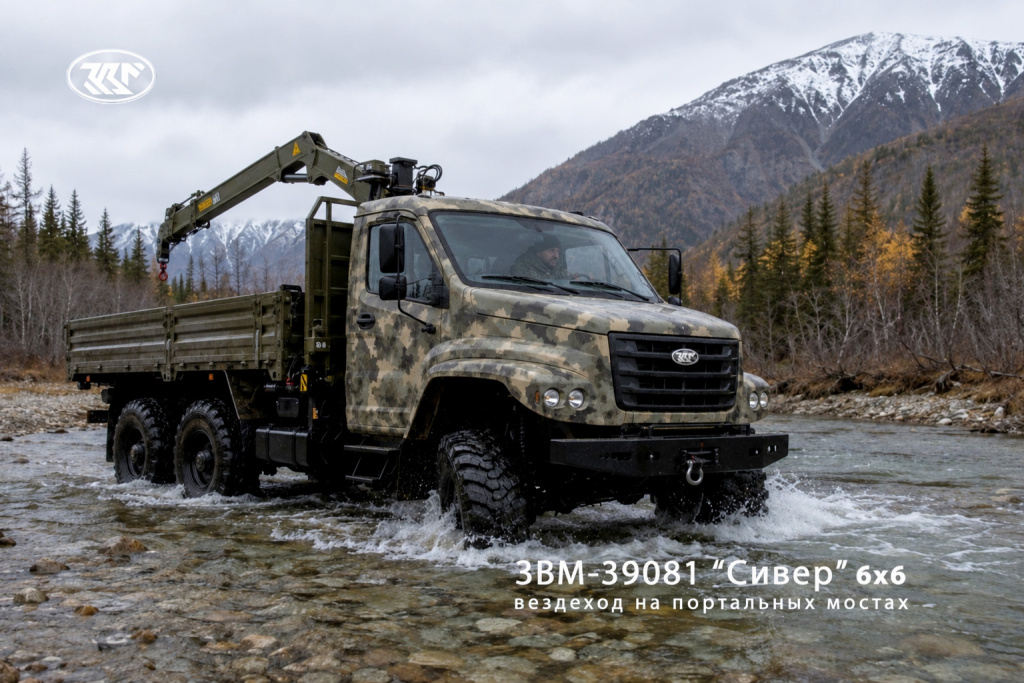
A winter road does not eliminate the off-road vehicle
A winter road is an excellent tool of northern logistics.
It allows road transport to be used where it is impossible in summer.
But a winter road is seasonal.
It depends on temperature, ground conditions, snow, and ice.
When natural conditions change, transport accessibility changes too.
Off-road vehicles solve a different task.
They make it possible not to wait until the territory becomes a road.
They work with the territory itself.
That is why off-road vehicles are especially in demand where sites are far from permanent infrastructure.
What if there is water on the way?
In the North this is a normal situation.
Rivers, channels, boggy areas, floods.
For ordinary road transport, a water obstacle often means the need to look for a detour, organize a crossing, or use additional transport infrastructure.
For an amphibious off-road vehicle, water can be part of the route.
And this changes the economics of transportation.
- The route becomes shorter.
- The number of auxiliary operations decreases.
- Transport depends less on the availability of bridges.
For a number of tasks, it is amphibious capability that becomes one of the main factors in choosing a machine.
What about heavy cargo?
Here an interesting paradox arises.
The greater the payload capacity, the heavier the machine.
The heavier the machine, the higher the load on the ground.
This means that for heavy transport the design of the propulsion system is especially important.
That is why specialized equipment includes different classes of machines:
- light wheeled snow-and-swamp vehicles
- heavy wheeled platforms
- tracked machines
- two-link off-road vehicles
Each class has its own zone of efficiency.
For example, a two-link design makes it possible to distribute mass differently and work on difficult, low-bearing ground.
The most expensive thing in the North is not always fuel
There is another indicator that is rarely taken into account in ordinary logistics.
The cost of non-delivery.
If a machine does not arrive:
- the crew stops
- equipment is idle
- the geological party is postponed
- installation is disrupted
- an additional helicopter is required
- a repeat trip is required
Therefore the right question for a business is not:
“How much does this machine cost?”
But:
“How much does it cost to guarantee completion of the transport task?”
And here specialized equipment may prove more profitable than ordinary equipment even with a higher initial cost.
Northern logistics of the future
The future does not mean that roads will appear everywhere.
Rather, a combined transport system will develop:
port → warehouse → highway → regional hub → off-road vehicle → site.
Or:
airport → base → off-road vehicle → remote site.
Or:
river → transshipment base → tracked vehicle → production site.
That is, the off-road vehicle becomes part of a unified logistics chain.
Not a replacement for all types of transport.
But the link that allows the final section of the route to exist at all.
Main conclusion
Northern logistics is not logistics on bad roads.
It is logistics where there may be no road at all.
And that is why off-road vehicles matter far beyond extreme tourism or expedition trips.
They make it possible to make territories accessible where building a permanent road is not always justified.
And the more actively the Arctic, Siberia, and remote areas are developed, the more important transport capable of operating directly on the ground will be.
Because sometimes the most effective way to establish a transport link is not to build a road.
But to create a machine that can go where there is no road.
Choosing such equipment begins not with the question of engine power or maximum payload capacity. It begins with an analysis of the route, soil type, season, nature of the cargo, and autonomy requirements. It is a comprehensive assessment of these conditions that makes it possible to determine which machine is truly suitable for a specific transport task.
ZVM — Off-Road Vehicle Plant
We develop and manufacture equipment for operation outside the road network.
More about ZVM off-road vehicles:
zvm-nn.ru
Subscribe to the new Dzen channel of the Off-Road Vehicle Plant: ZVM | By Our Own Rules

The ZVM Dzen channel (Off-Road Vehicle Plant) is not only about off-road vehicles, engineering, and technology, but also about our strange human habit of looking for a road to places where, it would seem, there is absolutely no reason to go.
Prepared by the Digital Communications Department of LLC “Off-Road Vehicle Plant” zvm-nn.ru
For cooperation and use of materials: digital@zvm-nn.ru