

25 September 2026
The Best Swamp: Do You Know Exactly What You Need?
Analyzing the Phenomenon of a Search Query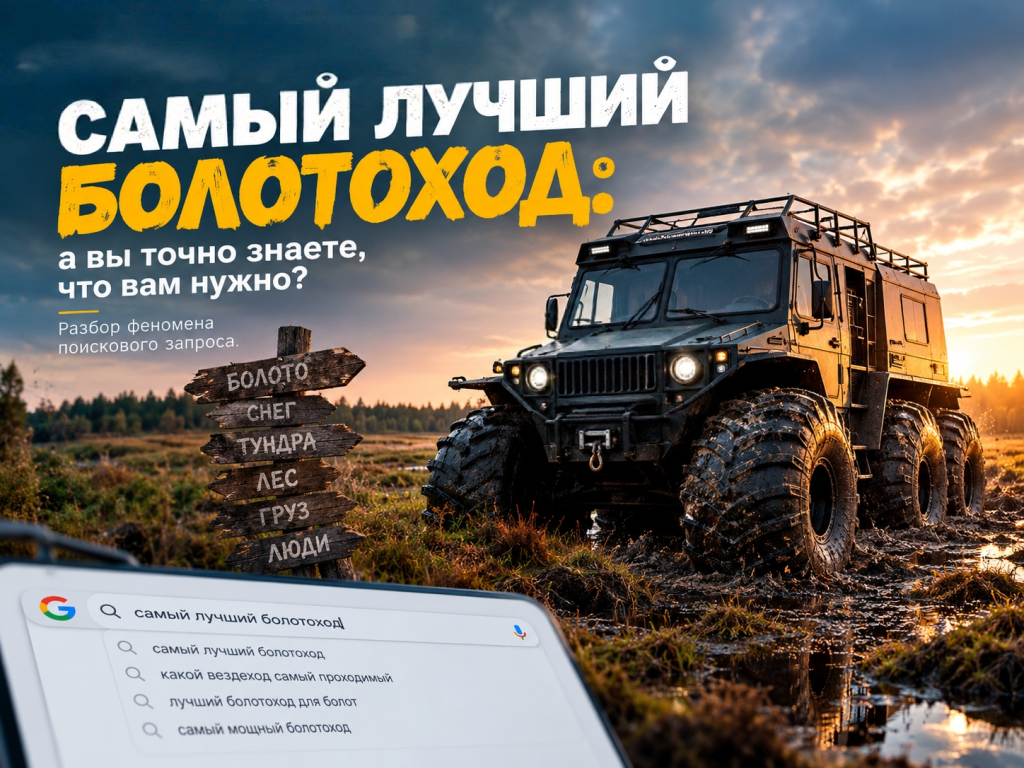
There are questions that a search engine answers in a fraction of a second.
“The best swamp vehicle.”
“Which off-road vehicle has the best cross-country ability?”
“Which snow-and-swamp vehicle is better to buy?”
“The most powerful off-road vehicle in Russia.”
“The best swamp vehicle for swamps.”
A person types a query, presses Enter, and expects that an honest answer will appear somewhere: here it is, the best one. Take it.
Preferably with a price, photos, specifications, and a “Buy” button.
But that is not how it works with off-road vehicles.
And perhaps this is a good opportunity to switch off the “give me the very best” mode for a few minutes and figure out how people actually choose equipment that has to work where there are no roads.
Because a good off-road vehicle is not chosen like a smartphone.
It does not have a specification “best — 97%.”
And if someone promises to name the very best swamp vehicle in general, the first thing to ask is:
The best for what?

What does “best” even mean?
Let’s imagine two machines.
The first is light, compact, and fairly economical. It is convenient for transporting people and a small load, and it can travel over snow, mud, swamp, and off-road terrain.
The second is a large, heavy machine designed for serious cargo, great autonomy, and harsh operating conditions.
Now let’s ask a simple question:
Which one is better?
If you need to take four people and several hundred kilograms of equipment to a remote site, the answer will be one.
If you need to deliver several tons of cargo to where any road ends, it will be completely different.
And if the machine has to carry a repair crew along a linear facility every day, the requirements change again.
So the technically correct question is not:
“Which swamp vehicle is the best?”
But this:
“Which swamp vehicle is best suited for my task?”
The difference between these two questions is roughly like the difference between “which car is the best?” and “which car do I need to carry construction equipment to a site every day?”
In the second case, at least there is a chance of getting a meaningful answer.
Why “the most capable off-road” is also not an answer
The next popular query is “the most capable off-road vehicle.”
It is even more interesting.
Because cross-country ability is not a single button that can be turned to maximum.
It is influenced by a whole set of parameters:
- machine mass;
- ground pressure;
- type of propulsion;
- size and design of tires or tracks;
- engine power and characteristics;
- transmission;
- ground clearance;
- geometric off-road ability;
- ability to overcome water obstacles;
- load;
- ground condition;
- driver experience.
And the last item sometimes makes you want to write in capital letters.
The same machine can behave completely differently on seemingly identical off-road terrain depending on who is behind the wheel and how competently the equipment is used.
Because an off-road vehicle is not a video game character that just needs to upgrade the “cross-country ability” stat.
Big wheels? Does that mean it’s the best?
Not necessarily.
Big wheels do give an off-road vehicle certain advantages. But at the same time, mass, dimensions, loads on the transmission, vehicle characteristics, and operating requirements change.
The same applies to engine power.
250 horsepower does not automatically make a machine twice as good as a machine with 125 horsepower.
If everything were that simple, engineers would only have to install a more powerful engine and award a bonus for every added kilowatt.
In practice, an off-road vehicle is a system.
The engine must match the transmission.
The transmission must match the loads.
The running gear must match the mass and operating conditions.
The propulsion unit must match the ground.
The payload capacity must match the actual task.
And the entire design as a whole must match the place the machine is supposed to reach.
That is why looking at a single impressive number in a specification table is not always useful.
An off-road vehicle is chosen based on the task, not the number of “horsepower”
Suppose you need to deliver people and equipment to a geological site.
Question No. 1 is not “how much horsepower?”
Question No. 1 is how many people and what kind of cargo?
Then:
Where do you need to go?
Snow?
Swamp?
Tundra?
Forest?
Sand?
Rocks?
Deep ruts?
Water?
And then:
How often?
Once a month?
Every day?
Seasonally?
All year round?
Because a machine for a one-time expedition and a machine that has to work every day at an industrial site are two different stories.
And the requirements for them will differ not only in cross-country ability.
Here fuel consumption, repairability, service life, service availability, capacity, payload capacity, autonomy, and many other parameters come into play.
That is why, in professional operation, the question “which one is the coolest?” usually quickly gives way to a much more boring but useful question:
“What exactly is this machine supposed to do?”

Wheeled or tracked?
And here real engineering begins.
Wheeled and tracked snow-and-swamp vehicles cannot simply be lined up from “bad” to “good.”
Each type of propulsion has its own characteristics and application areas.
Wheeled equipment can be especially interesting where mobility, travel speed, transport versatility, and the ability to work effectively on different types of surfaces are important.
Tracked equipment is used when driving on weak-bearing soils, snow, and swamps, and the need to distribute the load over a large area, come to the fore.
But even here one cannot say:
“Tracks are always better than wheels.”
Because the word “always” generally goes poorly with engineering.
Equipment has application conditions.
And the harder the task, the more important it is to understand these conditions before purchase, not after the first serious trip.
And what happens if you just buy the biggest one?
You’ll get a big off-road vehicle.
That’s true.
But then questions begin.
A large machine means large mass.
Large mass means corresponding requirements for transportation, maintenance, and infrastructure.
A more powerful engine has its own operating characteristics.
High payload capacity makes sense only when that cargo actually needs to be transported.
If you carry 300 kilograms where the machine is designed for several tons, a simple question arises:
Why?
It’s roughly like going to buy bread in a mining dump truck.
Possible.
Impressive.
But there’s not much engineering sense in it.
That is why ZVM does not have a single “best” off-road vehicle
And that, in fact, is completely normal.
The plant produces equipment of different classes precisely because operating conditions vary.
ZVM’s lineup includes wheeled snow-and-swamp vehicles of the VEYA family, off-road vehicles on portal axles SIVER, tracked snow-and-swamp vehicles UZOLA, two-link tracked vehicles – UNZHA and a couple of screw-propelled vehicle models..
And comparing them on the principle:
“Who will win in the category ‘the very best overall’?”
— is roughly the same as choosing between a truck, a minibus, and a tractor based on “which one is better.”
A much more interesting question is:
Which machine will solve a specific task more efficiently?
And here you can already discuss specifications concretely.
Five questions to ask yourself before buying a swamp vehicle
1. What are we transporting?
People?
Cargo?
Equipment?
Or all at once?
This will determine the requirements for the cabin, cargo platform, payload capacity, and layout of the machine.
2. How much does it weigh?
“A little equipment” is not a technical specification.
300 kg, 1 ton, and 5 tons are completely different tasks.
3. Where will it have to work?
The word “swamp” also does not explain very much.
There are different soils, depths, bearing capacities, water, vegetation, terrain changes, and seasonal changes.
Yesterday an off-road vehicle passed here, but in spring the same place may look completely different.
4. Does the machine need to swim?
This is a fundamental question.
Overcoming a water obstacle and regularly working as an amphibian are not the same thing.
5. How will the equipment be used?
For an expedition?
For hunting?
For geological exploration?
For an oil and gas facility?
For transporting people?
For forestry?
For work in the North?
The purpose of the machine must appear before the specific model.

And this is where the search query starts working correctly
In fact, the query “the best swamp vehicle” is completely normal.
A person simply starts searching from what is not yet clear to them.
That is natural.
What is abnormal is something else — to stop at the first attractive ranking and decide that the machine found there automatically suits you.
A search engine can show ten models.
Twenty.
A hundred.
It can tell you which machine has more horsepower, higher ground clearance, or larger tires.
But the search engine does not know what exactly you are going to do in the swamp next Tuesday at 9 a.m.
And that is precisely the most important information.
The best swamp vehicle does exist after all
It just looks different for everyone.
For one person, it is a compact machine that quickly delivers people to the work site.
For another, it is a heavy off-road vehicle capable of taking several tons of cargo on board.
For a third, it is tracked equipment for working on weak-bearing soils.
For a fourth, it is an amphibious machine for which a water obstacle is part of the route, not an emergency.
And each of them may well call their own off-road vehicle the best.
Because the criterion “best” did not come from advertising.
It came from the task.
Don’t look for the best. First determine what you need.
In short, choosing a snow-and-swamp vehicle can be reduced to a simple chain:
task → operating conditions → load → cross-country ability requirements → propulsion type → machine class → specific model
And not the other way around:
liked the photo → looked at the power → read reviews → “we’ll take it.”
The first path is called an engineering approach.
The second is buying based on TikTok.
Of course, we have nothing against TikTok.
But if an off-road vehicle must not simply drive beautifully through mud in a video, but for years carry people, equipment, and cargo where ordinary equipment cannot work, a few minutes spent properly calculating the task will definitely not be wasted.
So next time, when your hand automatically types into the search engine:
“the best swamp vehicle”
don’t erase the query.
Just add a few more words to it:
“for my task.”
That is when search truly becomes useful.
And if after that you still don’t understand which class of equipment you need, that is already a normal question.
Because a good off-road vehicle begins not with the answer to the question “which one is the best?” but with the right question: “what will it have to do?”
PS. And now — briefly about the snow-and-swamp vehicle itself
While we were analyzing the phenomenon of the query “the best swamp vehicle,” search engines managed to ask us several more quite reasonable questions.
What is a swamp vehicle? How does a snow-and-swamp vehicle differ from an ordinary off-road vehicle? What types of snow-and-swamp vehicles are there? Who manufactures them in Russia?
To avoid making the reader open another twenty tabs, we collected the main answers here. The result is a small mini-Wiki on snow-and-swamp vehicles — without encyclopedic tedium, but with the necessary minimum of terms.
What is a swamp vehicle?
In everyday speech, a “swamp vehicle” refers to an off-road vehicle capable of traveling over swampy terrain, weak-bearing soils, snow, and other difficult off-road conditions.
In technical documentation, the term “snow-and-swamp vehicle” is more often used.
According to GOST 34065-2017, a snow-and-swamp vehicle is a self-propelled transport vehicle intended for transporting passengers and/or cargo primarily over snowy and swampy off-road terrain outside public roads and equipped with wheeled or tracked propulsion.
That is, a snow-and-swamp vehicle is not just a car with big wheels. It is equipment whose design is initially intended for movement where ordinary road transport has nothing to do.
Is a snow-and-swamp vehicle an off-road vehicle?
In most everyday conversations, these words are used almost as synonyms, but strictly speaking, the concepts do not fully coincide.
Off-road vehicle is a broader concept. It refers to high-cross-country-capability equipment capable of operating outside ordinary roads.
Snow-and-swamp vehicle is a specific class of off-road equipment focused primarily on snow, swamps, and weak-bearing soils.
Therefore, a snow-and-swamp vehicle can be considered a type of off-road equipment, but far from every off-road vehicle is necessarily a snow-and-swamp vehicle.
What types of snow-and-swamp vehicles are there?
The simplest division is by type of propulsion.
Wheeled snow-and-swamp vehicles
They use special tires, including low-pressure tires, and are designed for movement over low-bearing-capacity soils, snow, mud, swamps, and other types of off-road terrain.
Wheeled machines can be compact or heavy, with 4×4, 6×6, and other configurations.
This class includes, for example, the VEYA and SIVER snow-and-swamp vehicles manufactured by ZVM.
Tracked snow-and-swamp vehicles
Tracks are used instead of wheels. A large support area allows the machine’s mass to be distributed over the ground and enables operation in areas with weak bearing capacity.
Tracked machines can be used to transport people and cargo, work in the tundra, on swamps, in virgin snow, and in other harsh conditions.
In ZVM’s lineup, this class includes UZOLA and the two-link snow-and-swamp vehicle UNZHA.
Two-link snow-and-swamp vehicles
This is a separate and interesting class of equipment. The machine consists of two interconnected links, each of which is part of a single transport vehicle.
This design makes it possible to increase capacity and payload capacity, as well as to work effectively on difficult off-road terrain.
A good example is the two-link tracked snow-and-swamp vehicle UNZHA.
Amphibious snow-and-swamp vehicles
Some machines are capable not only of moving over swampy terrain but also of overcoming water obstacles or moving on water.
But here it is important not to confuse two different characteristics:
“can overcome water” ≠ “designed for regular operation on water.”
The ability to float is a specific design property, while the need to regularly use the machine as an amphibian is already a requirement for its purpose and configuration.
Screw-propelled vehicles
There is also quite unusual equipment — machines with a rotary-screw propulsion unit.
Instead of ordinary wheels or tracks, rotating screw elements are used. This scheme is intended for very specific operating conditions.
In ZVM’s lineup, such equipment is represented by a separate direction — off-road vehicles with rotary-screw propulsion, or screw-propelled vehicles.
This is no longer “another big SUV,” but a completely different engineering approach to movement over weak-bearing surfaces.
How does a snow-and-swamp vehicle differ from an ordinary car?
The main difference is not the size of the wheels or how formidable the machine looks in a photograph.
An ordinary car is designed primarily for driving on roads with relatively predictable bearing capacity.
A snow-and-swamp vehicle must retain the ability to move where the support under the wheels or tracks may be soft, loose, deep, snow-covered, or swampy.
Therefore, when creating such equipment, great importance is attached to:
- ground pressure;
- machine mass;
- type and design of propulsion;
- size and characteristics of tires or tracks;
- ground clearance;
- geometric off-road ability;
- transmission characteristics;
- payload capacity;
- ability to overcome water obstacles;
- operating conditions.
That is why a snow-and-swamp vehicle cannot be adequately evaluated by engine power alone.
What brands of snow-and-swamp vehicles and off-road vehicles exist?
Here the search engine usually throws the user another trap: the query “all brands of swamp vehicles.”
No such universal list exists.
The market changes: new models and manufacturers appear, some machines are discontinued, others receive new modifications. In addition, the single word “off-road vehicle” can hide completely different classes of equipment — from compact machines to heavy industrial transporters.
Therefore, it is more correct to speak not of “all brands in the world,” but of specific classes and manufacturers.
Among Russian manufacturers and brands of off-road equipment represented in open catalogs and manufacturer materials, one can find, for example:
- ZVM — VEYA, SIVER, UZOLA, UNZHA, and equipment with specialized propulsion;
- TREKOL — a family of wheeled amphibious off-road vehicles on ultra-low-pressure tires;
- ZZGT — tracked snow-and-swamp vehicles and transporters, including GAZ-34039 Irbis, GAZ-3409 Bobr, and the two-link GAZ-3344.
This is not a ranking or an exhaustive list of the Russian market. These are merely a few examples of manufacturers and brands, to make clear how diverse off-road equipment can be.
Snow-and-swamp vehicles of Russian production
The Russian school of off-road vehicle engineering historically developed from the need to work across vast territories where road infrastructure is either absent or very conditional.
The North, tundra, taiga, swamps, geological exploration areas, oil and gas fields, power lines, remote industrial facilities — all of this shaped demand for high-cross-country-capability equipment.
Today the Russian market includes both wheeled snow-and-swamp vehicles and tracked, two-link, and specialized machines.
For example, Zavod Vezdekhodnykh Mashin (ZVM) produces the VEYA and SIVER wheeled snow-and-swamp vehicles, the tracked UZOLA, the two-link UNZHA, as well as equipment with rotary-screw propulsion.
Zavolzhsky Plant of Tracked Tractors produces a family of tracked equipment, including the GAZ-34039 Irbis, GAZ-3409 Bobr snow-and-swamp vehicles, and the two-link GAZ-3344.
The company TREKOL specializes in wheeled amphibious off-road vehicles and its own ultra-low-pressure tires.
And where is the ranking of Russian plants producing off-road vehicles?
And here again I want to slow down the search machine a little.
There is no single objective ranking of Russian off-road vehicle manufacturing enterprises based on “first place, second place, third place.”
And this is quite logical.
How can one compare a plant that produces heavy tracked transporters with a manufacturer of wheeled amphibians? Or an enterprise specializing in compact machines with a plant producing multi-ton equipment?
They can be compared by production volume.
They can be compared by payload capacity.
They can be compared by the number of models.
They can be compared by experience, delivery geography, service network, or specific technical characteristics.
But it will no longer be possible to derive from this a single honest figure: “the best plant in Russia.”
Therefore, it is much more useful to first determine which class of equipment is needed, and only then compare specific machines and manufacturers.
If very briefly
| Question | Short answer |
|---|---|
| What is a swamp vehicle? | Off-road equipment intended for movement over swamps and other difficult soils. |
| What is a snow-and-swamp vehicle? | A self-propelled off-road transport vehicle with wheeled or tracked propulsion, intended for operation primarily on snow and weak-bearing soils. |
| What types are there? | Wheeled, tracked, two-link, amphibious, and specialized machines, including screw-propelled vehicles. |
| Which brand is best? | Depends on the task, operating conditions, load, and requirements for the machine. |
| Which manufacturers are there in Russia? | The market includes several manufacturers and dozens of models of different classes. Among them are ZVM, TREKOL, ZZGT, and other enterprises. |
| Is there a ranking of plants? | There is no single objective ranking. It makes sense to compare manufacturers based on a specific task and specific criteria. |
And finally
If after all this you are still searching for “all brands of swamp vehicles,” then we don’t understand you.
But now at least you know what to look for.
Not just a brand.
Not just power.
Not just wheel size.
But equipment for a specific task.
Because a snow-and-swamp vehicle is not one universal car for everything in the world.
It is a large world of machines created for different conditions, loads, and routes.
And the sooner this becomes clear, the less likely you are to choose the “best” off-road vehicle for a completely wrong job.
Note: terminology and classification are given in accordance with current regulatory documents and open manufacturer data. The list of brands and enterprises is not an exhaustive ranking of the Russian market.
Prepared by the Digital Communications Department of LLC "Zavod Vezdekhodnykh Mashin" zvm-nn.ru
For cooperation and use of materials:
digital@zvm-nn.ru