

Назад
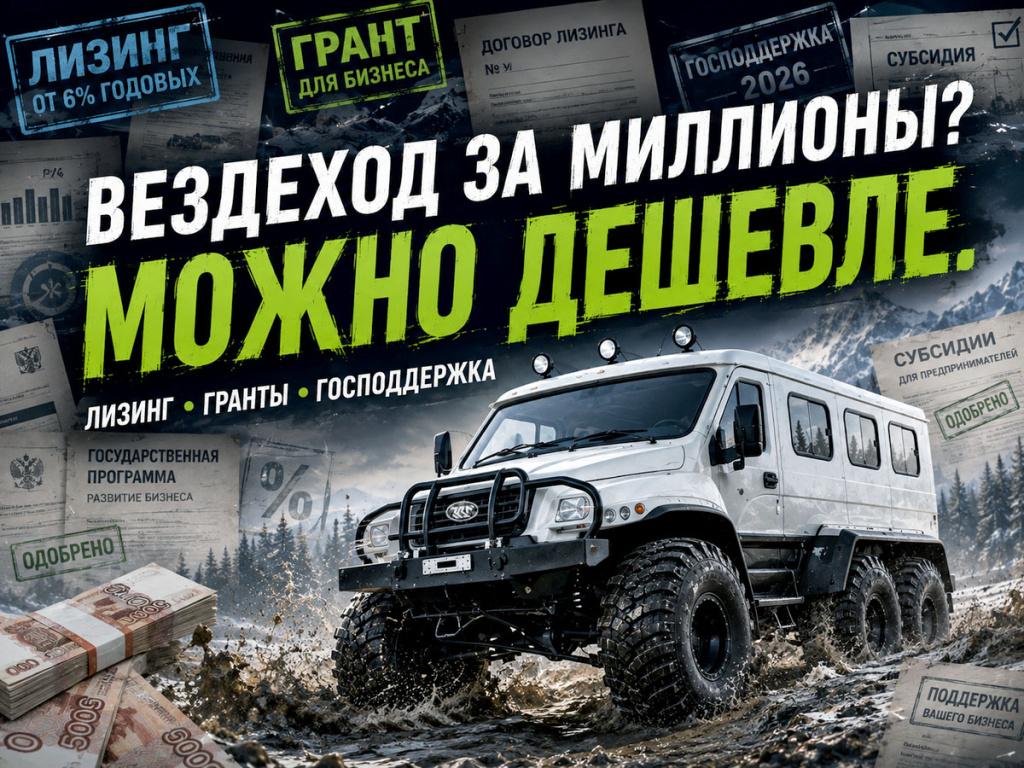 When it comes to a purchase costing several million rubles,
the main question for an entrepreneur is usually not "which vehicle should I choose?"
The real question is:
how can you acquire the necessary equipment without tying up all your available cash?
Businesses have several options:
leasing, subsidized programs, regional support measures, grants for tourism projects, and industry-specific programs.
Let’s break it down in plain language—without complex economics or fine print.
Leasing: avoiding a lump-sum payment
Leasing is the most straightforward option for businesses.
The concept is simple.
A leasing company purchases the vehicle, while the entrepreneur takes possession of it and pays off the cost over time.
In other words, instead of immediately withdrawing—say, several million rubles—from working capital, you can make an initial down payment and then pay according to a schedule.
This is particularly important for businesses.
It allows funds that weren't spent entirely on the vehicle to remain available for:
salaries;
fuel;
advertising;
launching the tourist season;
infrastructure construction;
purchasing equipment;
and day-to-day expenses.
As a result, the vehicle is already in operation,
while payments are made gradually.
And what is subsidized leasing?
This is where government support comes in.
Subsidized leasing programs are available for certain categories of entrepreneurs and specific types of equipment.
For instance, the SME Corporation runs programs where, for eligible transactions, the interest rate can be 6% per annum for Russian-made equipment and 8% for foreign-made equipment. However, not every entrepreneur automatically qualifies for such a rate; factors such as company status, type of business activity, equipment specifications, and the terms of the specific program all play a role. So, the golden rule here is:
don’t simply trust an advertised figure like "leasing starting at 6%"; instead, first verify whether the specific deal qualifies for the program.
You can do this even before purchasing the equipment.
An important point: Russian-made equipment is a plus, but it doesn't guarantee automatic approval.
For many government programs, the equipment's origin is a crucial factor.
And this is where domestic manufacturers have a clear advantage.
However, the assumption that
"It's Russian equipment, so we'll get approved for subsidized leasing"
would be incorrect.
Government programs vary widely.
Some specify a particular list of equipment.
Others impose requirements on the manufacturer.
Some focus on the buyer's type of business activity.
Others have restrictions based on region, business size, or other parameters.
Therefore, the right approach is:
first check the program → then check the equipment → then calculate the leasing terms.
Can you get assistance from the region?
Yes.
And this is an avenue certainly worth exploring.
In addition to federal programs, regions have their own measures to support entrepreneurs.
These might include:
subsidized leasing;
subsidies;
grants;
partial cost reimbursement;
support programs for the tourism industry;
assistance for specific sectors.
Conditions vary from place to place.
So, for an entrepreneur in Perm Krai, for instance, it makes no sense to focus solely on federal programs. You need to specifically look at what is available in Perm Krai.
The same applies to Altai, Yakutia, Khabarovsk Krai, Magadan Oblast, and other regions.
Sometimes, a regional program turns out to be more attractive for a specific business than a federal one.
Tourism: the opportunities here are particularly interesting.
An all-terrain vehicle (ATV) can be more than just a means of transport.
For a tourism business, it can be part of the tourism product itself.
For example:
· winter expeditions;
· trips through the taiga;
· routes to remote natural landmarks; · hunting and fishing tours;
· expedition programs;
· tourist transfers;
· family and group trips;
· routes through areas inaccessible by standard vehicles.
That is precisely why support programs for tourism projects are in place across various regions.
Under the "Tourism and Hospitality" national project, regions receive funding to develop tourism infrastructure and projects.
However, there is an important caveat.
Receiving a grant does not mean you can simply buy any all-terrain vehicle that catches your eye.
The specific competition rules dictate exactly what the funds may be spent on.
Therefore, you must first review the program terms before including the vehicle in your business plan.
How might this work in practice?
Let’s say an entrepreneur wants to launch expedition-style tourism routes.
They need an all-terrain vehicle (ATV/amphibious vehicle).
There are two paths to take.
Option one
Pay for the vehicle upfront using personal funds.
The vehicle becomes theirs immediately, and there is no interest to pay on a lease.
However, a large sum of money is removed from the business's working capital.
Option two
Use a leasing arrangement.
Make a down payment, take delivery of the vehicle, and pay off the cost gradually.
Keep the remaining funds available for business operations.
Option three
If the project qualifies for a regional tourism support program, try to secure a grant or subsidy.
Then, determine the best financing arrangement for the remaining balance.
This third option might well prove to be the most attractive one.
However, everything depends on the terms of the specific grant competition.
Don't forget: a grant isn't just "free money for a vehicle."
This is a crucial point.
Grant funding is typically awarded for a specific project and specific objectives.
The entrepreneur must demonstrate that the project meets the program's requirements.
You may need to provide:
– a business plan;
– your own co-financing;
– proof of expenses;
– equipment documentation;
– progress reports;
– evidence of meeting project targets.
Therefore, it is best not to buy the equipment beforehand in the hope of getting reimbursed later.
You need to find out the specific program's rules first.
What if the business operates in the North?
The situation there is even more interesting.
All-terrain vehicles (ATVs) are in demand where standard vehicles simply cannot cope.
For example:
– in reindeer herding operations;
– at remote industrial sites;
– for expeditions;
– in forestry;
– in geological exploration;
– in the tourism industry;
– for servicing remote areas.
Some northern regions have special support measures for specific industries and types of operations.
But the same rule applies here:
check the program terms first, then choose the equipment.
What about discounts on Russian-made equipment?
That mechanism exists, too.
The state can support Russian equipment manufacturers, including through programs that subsidize discounts for buyers.
However, even here, you cannot promise a buyer a specific discount simply because the equipment is domestic.
You need to verify:
– whether the manufacturer participates in the relevant program;
– whether the specific model is on the approved list;
– whether it meets the established requirements;
– whether the program is active at the time of the transaction. So, a good question to ask the seller isn't:
"Do you offer a government-subsidized discount?"
But rather:
"Is this specific model eligible for the current program, and can you provide documentation to confirm that?"
These are two completely different things.
The most overlooked aspect of the purchase isn't the vehicle's price, but the cost of owning and operating it.
Let’s say you’ve found a good option.
The price works for you.
Leasing has been approved.
The contract is signed.
But the expenses don't stop there.
When buying an all-terrain vehicle (ATV), you need to factor in the following from the start:
·down payment;
·monthly lease payment;
·insurance;
·delivery;
·maintenance;
·fuel;
·consumables;
·spare parts;
·storage;
·driver or crew wages;
·taxes and other mandatory costs.
That’s why the question:
"How much does the all-terrain vehicle cost?"
isn't quite the right one.
It’s better to ask:
"How much will it cost me to run each month?"
And another question: how much revenue should it generate?
This is especially important for a business.
If the vehicle is being purchased for tourist routes, you need to calculate in advance:
— how many trips per month does it need to make to cover its own costs?
For example:
If the total monthly costs for the vehicle come to, say, 300,000 rubles, the machine needs to bring in more than that amount.
Otherwise, the business will have to pay for its upkeep out of pocket.
That’s why, before buying, it’s worth calculating at least three scenarios:
Optimistic —
A good season with high utilization.
Realistic —
Average utilization without inflated expectations.
Challenging —
A short season with fewer orders than expected.
If the project remains viable even with less-than-ideal utilization, that’s a good sign. Leasing isn’t always "more expensive and a bad idea"
You might hear people say:
"Why lease? It’s easier to save up and buy it outright."
If you truly have the funds and withdrawing them from the business won’t affect operations, then perhaps that is the best approach.
But business rarely operates in a perfect vacuum.
An entrepreneur simultaneously needs money for advertising, salaries, fuel, repairs, construction, new projects, and unforeseen expenses.
That’s why it is sometimes more advantageous to keep some capital working in the business rather than spending it all on a vehicle.
Leasing is, first and foremost, a cash flow management tool.
Then there are taxes
When purchasing expensive equipment, it is worth discussing the deal with an accountant beforehand.
Factors that may matter include:
VAT;
corporate income tax;
depreciation;
accounting treatment of the equipment;
regional tax incentives;
investment tax credit.
A federal investment tax credit exists, but it does not apply to all organizations or all types of purchases. Eligibility depends, among other things, on the type of business activity and other conditions.
Therefore, it is best to calculate the tax implications before signing the contract, not after.
Which option should you choose?
There is no one-size-fits-all answer.
However, you can use a simple framework:
If you have spare cash and the purchase won’t affect working capital, consider an outright purchase.
If preserving working capital is a priority, look into leasing.
If the business qualifies for a subsidized program, check out preferential leasing options.
If it’s a tourism project, we definitely look into regional grants and subsidies.
If the business operates in a specialized sector or a northern region, we seek out industry-specific support measures.
Sometimes, the smartest approach is to combine several tools.
The main thing is not to start with the purchase itself.
This is where many entrepreneurs make the same mistake.
First, they choose the vehicle.
Then, they find out the price.
Finally, they start thinking about where to get the money.
It is better to do it the other way around.
First:
What does the machinery need to do?
Then:
How much revenue or savings can it generate?
Next:
What support programs are available?
And only then:
Which specific vehicle should be bought, and how should it be financed?
This significantly reduces the risk of making a mistake.
The ZVM-39083 "VEYA": machinery built for where the road ends.
It is worth noting that the ZVM-39083 "VEYA" 6x6 all-terrain vehicle is not a modified version of a standard production car.
It is an original design built on a proprietary chassis.
Its key features include:
a reinforced frame;
proprietary portal axles;
600 mm ground clearance;
six driven wheels;
low-pressure tires;
an all-metal welded body;
a 150 hp diesel engine;
capacity to transport up to 10 people or a significant amount of cargo.
·Portal axles allow the main drivetrain components to be positioned above the wheel-axle line.
·Low-pressure tires help navigate snow, mud, and marshy terrain.
·This is a vehicle for "heavy-duty" work, not just for a pretty photo from an expedition tour.
Its mission is to go where ordinary vehicles cannot.
Can you acquire the "VEYA" through a subsidized lease or purchase it using a grant?
We won't promise the impossible here. Whether the ZVM-39083 qualifies for a specific program depends on that program's terms, the buyer's status, the region, the type of business activity, and the vehicle's specifications.
However, we are ready to provide the necessary documentation and vehicle specifications so the buyer can verify eligibility for a chosen program.
If you are an entrepreneur, a tourism company, an organization operating in remote areas, or a business representative in need of this type of vehicle, it makes sense to first identify available financing options.
Only then should you make a purchasing decision.
What should you do before buying?
We recommend taking just five steps:
1. Define the objective.
Determine what the all-terrain vehicle is needed for and how many months a year it will be in operation.
2. Calculate the budget.
Determine how much can be paid upfront and what monthly payment amount is comfortable for the business.
3. Check for government support.
Look into federal and regional programs, grants, and subsidized leasing options.
4. Compare offers.
Consider not just the interest rate, but also the down payment, the term, and the total cost of payments.
5. Only then select the configuration and finalize the purchase.
Key Takeaway
Purchasing an expensive all-terrain vehicle does not necessarily mean the entire sum must immediately leave the business's accounts.
Various financial instruments are available.
Leasing allows you to spread payments out over time.
Subsidized programs can lower financing costs for those who meet the eligibility criteria.
Regional programs may sometimes provide additional support.
Tourism projects may qualify for grant funding, provided specific expenses are covered by the terms of the grant competition.
Tax incentives can also impact the project's overall economics.
But most importantly, evaluate the deal as a whole.
Consider more than just the vehicle's price.
More than just the leasing interest rate.
And more than just the grant amount.
Consider the initial capital required, the monthly cost of the vehicle, and the revenue it can generate or the savings it can provide.
That way, the all-terrain vehicle becomes not just an expensive purchase, but a productive business asset. Want to find out which financing option is right for you?
Tell us what tasks the vehicle will be used for, your region, and the type of buyer—whether a limited liability company (LLC), an individual entrepreneur, an organization, or a private individual.
We will help you select the best financing plan and prepare the necessary information regarding the ZVM-39083 to pre-check eligibility for leasing or participation in a suitable support program.
ZVM "VEYA" 6x6 — playing by its own rules.
Where the roads end, its work begins.
Terms of government programs, vehicle lists, recipient requirements, and funding amounts are subject to change. Before signing a contract, please verify the current terms of the specific program and ensure that both the buyer and the vehicle meet the requirements.
For consultations regarding government financial programs, please contact us directly:
+7 920-058-2840 (MAX, Telegram)
E-mail: sales@zvm-nn.ru
16 September 2026
Leasing, grants, and state support in 2026: how to buy an all-terrain vehicle costing several million
An all-terrain vehicle is a significant investment.
When it comes to a purchase costing several million rubles,the main question for an entrepreneur is usually not "which vehicle should I choose?"
The real question is:
how can you acquire the necessary equipment without tying up all your available cash?
Businesses have several options:
leasing, subsidized programs, regional support measures, grants for tourism projects, and industry-specific programs.
Let’s break it down in plain language—without complex economics or fine print.
Leasing: avoiding a lump-sum payment
Leasing is the most straightforward option for businesses.
The concept is simple.
A leasing company purchases the vehicle, while the entrepreneur takes possession of it and pays off the cost over time.
In other words, instead of immediately withdrawing—say, several million rubles—from working capital, you can make an initial down payment and then pay according to a schedule.
This is particularly important for businesses.
It allows funds that weren't spent entirely on the vehicle to remain available for:
salaries;
fuel;
advertising;
launching the tourist season;
infrastructure construction;
purchasing equipment;
and day-to-day expenses.
As a result, the vehicle is already in operation,
while payments are made gradually.
And what is subsidized leasing?
This is where government support comes in.
Subsidized leasing programs are available for certain categories of entrepreneurs and specific types of equipment.
For instance, the SME Corporation runs programs where, for eligible transactions, the interest rate can be 6% per annum for Russian-made equipment and 8% for foreign-made equipment. However, not every entrepreneur automatically qualifies for such a rate; factors such as company status, type of business activity, equipment specifications, and the terms of the specific program all play a role. So, the golden rule here is:
don’t simply trust an advertised figure like "leasing starting at 6%"; instead, first verify whether the specific deal qualifies for the program.
You can do this even before purchasing the equipment.
An important point: Russian-made equipment is a plus, but it doesn't guarantee automatic approval.
For many government programs, the equipment's origin is a crucial factor.
And this is where domestic manufacturers have a clear advantage.
However, the assumption that
"It's Russian equipment, so we'll get approved for subsidized leasing"
would be incorrect.
Government programs vary widely.
Some specify a particular list of equipment.
Others impose requirements on the manufacturer.
Some focus on the buyer's type of business activity.
Others have restrictions based on region, business size, or other parameters.
Therefore, the right approach is:
first check the program → then check the equipment → then calculate the leasing terms.
Can you get assistance from the region?
Yes.
And this is an avenue certainly worth exploring.
In addition to federal programs, regions have their own measures to support entrepreneurs.
These might include:
subsidized leasing;
subsidies;
grants;
partial cost reimbursement;
support programs for the tourism industry;
assistance for specific sectors.
Conditions vary from place to place.
So, for an entrepreneur in Perm Krai, for instance, it makes no sense to focus solely on federal programs. You need to specifically look at what is available in Perm Krai.
The same applies to Altai, Yakutia, Khabarovsk Krai, Magadan Oblast, and other regions.
Sometimes, a regional program turns out to be more attractive for a specific business than a federal one.
Tourism: the opportunities here are particularly interesting.
An all-terrain vehicle (ATV) can be more than just a means of transport.
For a tourism business, it can be part of the tourism product itself.
For example:
· winter expeditions;
· trips through the taiga;
· routes to remote natural landmarks; · hunting and fishing tours;
· expedition programs;
· tourist transfers;
· family and group trips;
· routes through areas inaccessible by standard vehicles.
That is precisely why support programs for tourism projects are in place across various regions.
Under the "Tourism and Hospitality" national project, regions receive funding to develop tourism infrastructure and projects.
However, there is an important caveat.
Receiving a grant does not mean you can simply buy any all-terrain vehicle that catches your eye.
The specific competition rules dictate exactly what the funds may be spent on.
Therefore, you must first review the program terms before including the vehicle in your business plan.
How might this work in practice?
Let’s say an entrepreneur wants to launch expedition-style tourism routes.
They need an all-terrain vehicle (ATV/amphibious vehicle).
There are two paths to take.
Option one
Pay for the vehicle upfront using personal funds.
The vehicle becomes theirs immediately, and there is no interest to pay on a lease.
However, a large sum of money is removed from the business's working capital.
Option two
Use a leasing arrangement.
Make a down payment, take delivery of the vehicle, and pay off the cost gradually.
Keep the remaining funds available for business operations.
Option three
If the project qualifies for a regional tourism support program, try to secure a grant or subsidy.
Then, determine the best financing arrangement for the remaining balance.
This third option might well prove to be the most attractive one.
However, everything depends on the terms of the specific grant competition.
Don't forget: a grant isn't just "free money for a vehicle."
This is a crucial point.
Grant funding is typically awarded for a specific project and specific objectives.
The entrepreneur must demonstrate that the project meets the program's requirements.
You may need to provide:
– a business plan;
– your own co-financing;
– proof of expenses;
– equipment documentation;
– progress reports;
– evidence of meeting project targets.
Therefore, it is best not to buy the equipment beforehand in the hope of getting reimbursed later.
You need to find out the specific program's rules first.
What if the business operates in the North?
The situation there is even more interesting.
All-terrain vehicles (ATVs) are in demand where standard vehicles simply cannot cope.
For example:
– in reindeer herding operations;
– at remote industrial sites;
– for expeditions;
– in forestry;
– in geological exploration;
– in the tourism industry;
– for servicing remote areas.
Some northern regions have special support measures for specific industries and types of operations.
But the same rule applies here:
check the program terms first, then choose the equipment.
What about discounts on Russian-made equipment?
That mechanism exists, too.
The state can support Russian equipment manufacturers, including through programs that subsidize discounts for buyers.
However, even here, you cannot promise a buyer a specific discount simply because the equipment is domestic.
You need to verify:
– whether the manufacturer participates in the relevant program;
– whether the specific model is on the approved list;
– whether it meets the established requirements;
– whether the program is active at the time of the transaction. So, a good question to ask the seller isn't:
"Do you offer a government-subsidized discount?"
But rather:
"Is this specific model eligible for the current program, and can you provide documentation to confirm that?"
These are two completely different things.
The most overlooked aspect of the purchase isn't the vehicle's price, but the cost of owning and operating it.
Let’s say you’ve found a good option.
The price works for you.
Leasing has been approved.
The contract is signed.
But the expenses don't stop there.
When buying an all-terrain vehicle (ATV), you need to factor in the following from the start:
·down payment;
·monthly lease payment;
·insurance;
·delivery;
·maintenance;
·fuel;
·consumables;
·spare parts;
·storage;
·driver or crew wages;
·taxes and other mandatory costs.
That’s why the question:
"How much does the all-terrain vehicle cost?"
isn't quite the right one.
It’s better to ask:
"How much will it cost me to run each month?"
And another question: how much revenue should it generate?
This is especially important for a business.
If the vehicle is being purchased for tourist routes, you need to calculate in advance:
— how many trips per month does it need to make to cover its own costs?
For example:
If the total monthly costs for the vehicle come to, say, 300,000 rubles, the machine needs to bring in more than that amount.
Otherwise, the business will have to pay for its upkeep out of pocket.
That’s why, before buying, it’s worth calculating at least three scenarios:
Optimistic —
A good season with high utilization.
Realistic —
Average utilization without inflated expectations.
Challenging —
A short season with fewer orders than expected.
If the project remains viable even with less-than-ideal utilization, that’s a good sign. Leasing isn’t always "more expensive and a bad idea"
You might hear people say:
"Why lease? It’s easier to save up and buy it outright."
If you truly have the funds and withdrawing them from the business won’t affect operations, then perhaps that is the best approach.
But business rarely operates in a perfect vacuum.
An entrepreneur simultaneously needs money for advertising, salaries, fuel, repairs, construction, new projects, and unforeseen expenses.
That’s why it is sometimes more advantageous to keep some capital working in the business rather than spending it all on a vehicle.
Leasing is, first and foremost, a cash flow management tool.
Then there are taxes
When purchasing expensive equipment, it is worth discussing the deal with an accountant beforehand.
Factors that may matter include:
VAT;
corporate income tax;
depreciation;
accounting treatment of the equipment;
regional tax incentives;
investment tax credit.
A federal investment tax credit exists, but it does not apply to all organizations or all types of purchases. Eligibility depends, among other things, on the type of business activity and other conditions.
Therefore, it is best to calculate the tax implications before signing the contract, not after.
Which option should you choose?
There is no one-size-fits-all answer.
However, you can use a simple framework:
If you have spare cash and the purchase won’t affect working capital, consider an outright purchase.
If preserving working capital is a priority, look into leasing.
If the business qualifies for a subsidized program, check out preferential leasing options.
If it’s a tourism project, we definitely look into regional grants and subsidies.
If the business operates in a specialized sector or a northern region, we seek out industry-specific support measures.
Sometimes, the smartest approach is to combine several tools.
The main thing is not to start with the purchase itself.
This is where many entrepreneurs make the same mistake.
First, they choose the vehicle.
Then, they find out the price.
Finally, they start thinking about where to get the money.
It is better to do it the other way around.
First:
What does the machinery need to do?
Then:
How much revenue or savings can it generate?
Next:
What support programs are available?
And only then:
Which specific vehicle should be bought, and how should it be financed?
This significantly reduces the risk of making a mistake.
The ZVM-39083 "VEYA": machinery built for where the road ends.
It is worth noting that the ZVM-39083 "VEYA" 6x6 all-terrain vehicle is not a modified version of a standard production car.
It is an original design built on a proprietary chassis.
Its key features include:
a reinforced frame;
proprietary portal axles;
600 mm ground clearance;
six driven wheels;
low-pressure tires;
an all-metal welded body;
a 150 hp diesel engine;
capacity to transport up to 10 people or a significant amount of cargo.
·Portal axles allow the main drivetrain components to be positioned above the wheel-axle line.
·Low-pressure tires help navigate snow, mud, and marshy terrain.
·This is a vehicle for "heavy-duty" work, not just for a pretty photo from an expedition tour.
Its mission is to go where ordinary vehicles cannot.
Can you acquire the "VEYA" through a subsidized lease or purchase it using a grant?
We won't promise the impossible here. Whether the ZVM-39083 qualifies for a specific program depends on that program's terms, the buyer's status, the region, the type of business activity, and the vehicle's specifications.
However, we are ready to provide the necessary documentation and vehicle specifications so the buyer can verify eligibility for a chosen program.
If you are an entrepreneur, a tourism company, an organization operating in remote areas, or a business representative in need of this type of vehicle, it makes sense to first identify available financing options.
Only then should you make a purchasing decision.
What should you do before buying?
We recommend taking just five steps:
1. Define the objective.
Determine what the all-terrain vehicle is needed for and how many months a year it will be in operation.
2. Calculate the budget.
Determine how much can be paid upfront and what monthly payment amount is comfortable for the business.
3. Check for government support.
Look into federal and regional programs, grants, and subsidized leasing options.
4. Compare offers.
Consider not just the interest rate, but also the down payment, the term, and the total cost of payments.
5. Only then select the configuration and finalize the purchase.
Key Takeaway
Purchasing an expensive all-terrain vehicle does not necessarily mean the entire sum must immediately leave the business's accounts.
Various financial instruments are available.
Leasing allows you to spread payments out over time.
Subsidized programs can lower financing costs for those who meet the eligibility criteria.
Regional programs may sometimes provide additional support.
Tourism projects may qualify for grant funding, provided specific expenses are covered by the terms of the grant competition.
Tax incentives can also impact the project's overall economics.
But most importantly, evaluate the deal as a whole.
Consider more than just the vehicle's price.
More than just the leasing interest rate.
And more than just the grant amount.
Consider the initial capital required, the monthly cost of the vehicle, and the revenue it can generate or the savings it can provide.
That way, the all-terrain vehicle becomes not just an expensive purchase, but a productive business asset. Want to find out which financing option is right for you?
Tell us what tasks the vehicle will be used for, your region, and the type of buyer—whether a limited liability company (LLC), an individual entrepreneur, an organization, or a private individual.
We will help you select the best financing plan and prepare the necessary information regarding the ZVM-39083 to pre-check eligibility for leasing or participation in a suitable support program.
ZVM "VEYA" 6x6 — playing by its own rules.
Where the roads end, its work begins.
Terms of government programs, vehicle lists, recipient requirements, and funding amounts are subject to change. Before signing a contract, please verify the current terms of the specific program and ensure that both the buyer and the vehicle meet the requirements.
For consultations regarding government financial programs, please contact us directly:
+7 920-058-2840 (MAX, Telegram)
E-mail: sales@zvm-nn.ru