

Назад
Costs for fuel, maintenance, repairs, spare parts, logistics and downtime directly affect the economics of operation.
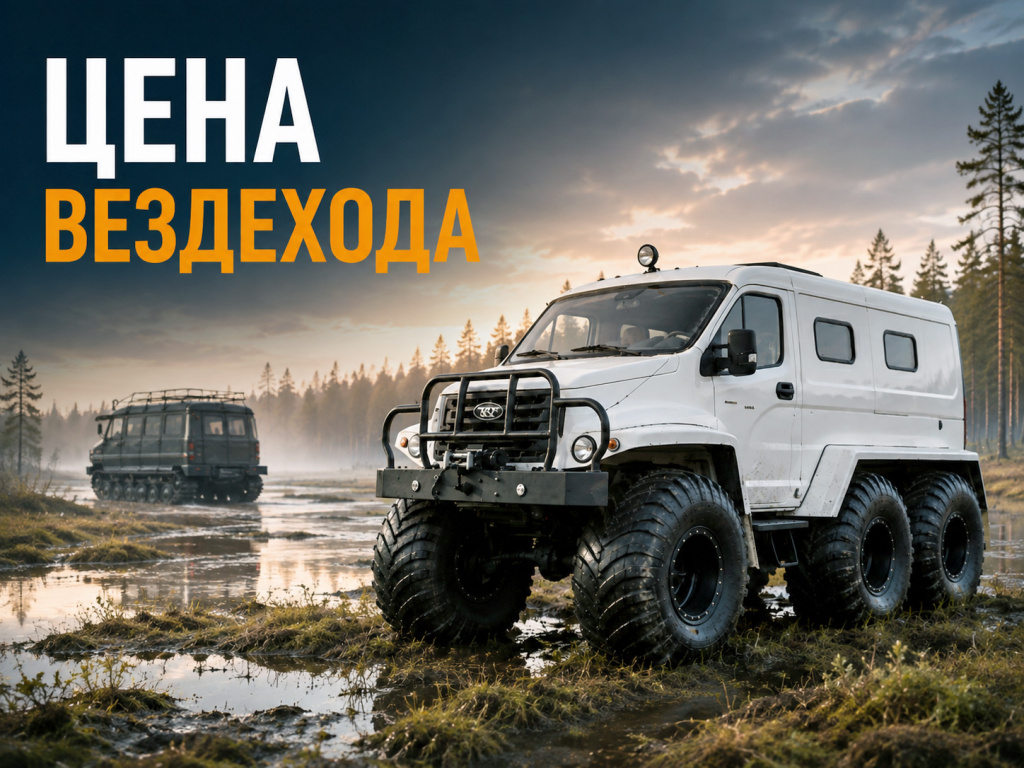 In this article, we look at what makes up TCO - total cost of ownership, and why when comparing equipment it is important to evaluate not only the acquisition cost, but also future operating costs.
When choosing an industrial all-terrain vehicle
the price in the commercial offer is only the first digit. To understand how much equipment will actually cost an enterprise, it is necessary to take into account the total cost of ownership - TCO (Total Cost of Ownership).
For equipment that operates in remote areas, in swamps, snow, winter roads and off-road conditions, this approach is especially important. A machine may cost less to purchase, but be significantly more expensive to operate. Conversely, a higher initial cost may be justified by lower costs for fuel, maintenance, repairs and downtime. Therefore, the right question when choosing an all-terrain vehicle is not: “How much does the machine cost?”, but: “How much will it cost to operate throughout its entire service life?”
What is TCO
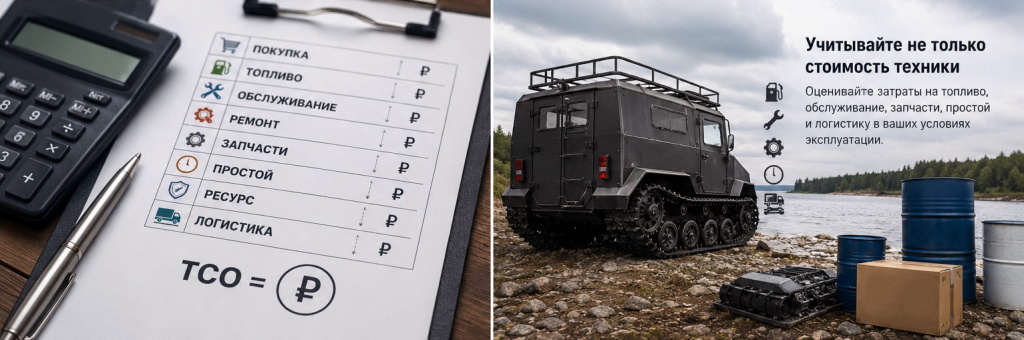
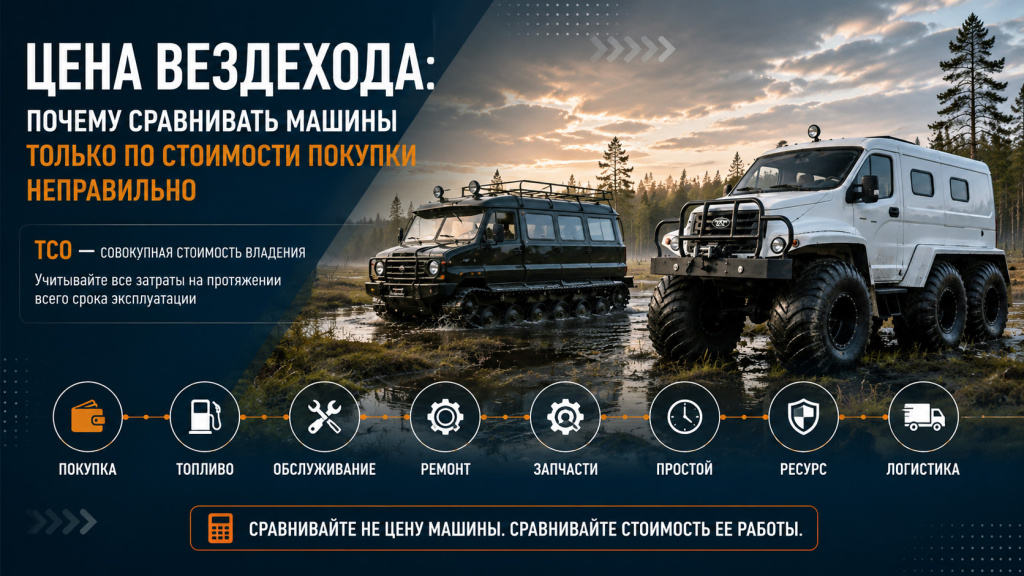
TCO (Total Cost of Ownership) – the total cost of owning equipment over the entire period of its operation. For an industrial all-terrain vehicle it includes:
– acquisition cost;
- fuel;
– scheduled maintenance;
- repair;
– spare parts and consumables;
– simple technology;
– resource of main nodes;
– transportation and logistics;
– costs for additional equipment;
– in some cases – training of personnel and organization of service support.
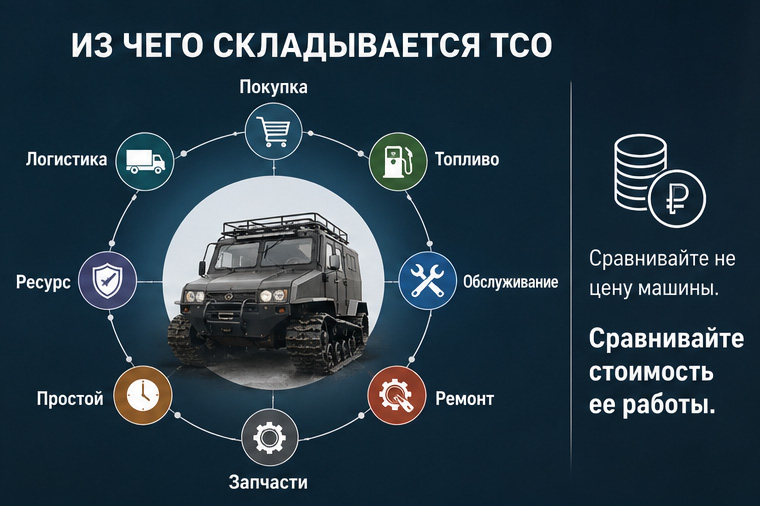
It turns out a simple formula:
TCO = purchase + operation + maintenance + repairs + downtime + logistics + other expenses during the ownership period.
That is why it is incorrect to compare two all-terrain vehicles based only on the purchase price.
1. Purchase price is just the beginning of the calculation
Let's imagine two cars: all-terrain vehicle A costs less, all-terrain vehicle B costs more.
At the procurement stage, the decision seems obvious: why pay more? But after several years of operation the situation may change. One car can have:
– higher fuel consumption;
– more expensive or rare components;
– complex maintenance;
– long delivery of spare parts;
– long-term repairs;
– the need to use a specialized service;
– more downtime.
Price of an all-terrain vehicle - buy cheaper or more expensive - review - ZVM
As a result, the initial savings gradually disappear.
Therefore, when purchasing industrial equipment, it is important to look not only at CAPEX - initial capital costs, but also at OPEX - operating costs.
2. Fuel: small difference turns into big money
For commercial and industrial applications, fuel is often one of the most prominent costs. It’s not just the passport expense that matters here. Actual costs are affected by:
– engine type;
– vehicle weight;
- loading;
– route status;
- temperature;
– driving mode;
– duration of idling;
– nature of the soil;
– driver qualifications.
Therefore, it is more correct to calculate not the abstract indicator “liters per 100 km”, but the cost of performing a specific production task.
For example, if an all-terrain vehicle delivers employees to a remote site every day, it is important to take into account not only the mileage, but also the number of work shifts, the seasonality of the route and the duration of operation.
For the current line of snow and swamp-going vehicles "VEYA" ZVM offers several platform options - 4x4 and 6x6, with different tire sizes. This approach allows you to select a machine for operating conditions, rather than using an excessively heavy configuration where it is not required.
The main principle: the technique must be suitable for the task. Overpaying for extra features is also part of the cost of ownership.
3. Maintenance: it is important not only “how much maintenance costs”
Scheduled maintenance is inevitable for any industrial equipment. But for different machines, the cost and duration of maintenance may vary significantly. When choosing an all-terrain vehicle, you should find out in advance:
– maintenance frequency;
– list of routine maintenance;
– availability of consumables;
– cost of main components;
– possibility of service by our own specialists;
– the need for a special tool;
– availability of manufacturer’s service support.
The last one is especially important.
An all-terrain vehicle that operates hundreds or thousands of kilometers from the nearest populated area must be designed not only for high cross-country ability, but also for maintenance in real operating conditions.
For the All-Terrain Vehicle Plant (ATV), maintainability and component standardization are key design principles. The company emphasizes the use of standardized parts and components for Russian-made vehicles, which simplifies maintenance and repair.
4. Spare Parts: Part Price Isn't the Only Indicator
Let's say a necessary part is inexpensive. But if you have to wait several weeks for it and the vehicle is down during that time, the low price of the part is no longer of much importance. Therefore, when choosing an industrial all-terrain vehicle, it's important to evaluate:
Part Cost + Delivery Time + Availability + Repair Time.
For an enterprise, this is much more important than just the price of an individual component.
This is especially relevant for remote sites in the oil and gas, energy, geological exploration, and other industries, where vehicle downtime can disrupt production.
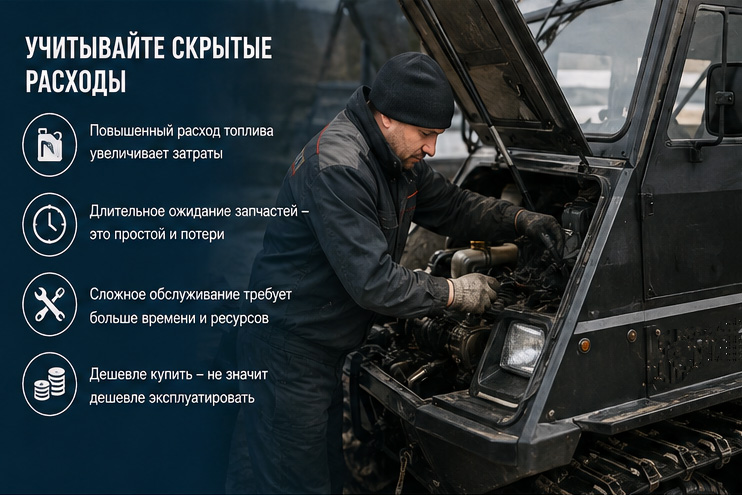
5. Repair: How Much Does an Hour of Downtime Cost?
This is one of the most underestimated components of TCO. Let's imagine that an all-terrain vehicle has broken down.
The repair itself may cost, for example, a relatively small amount.
But at the same time, the company may lose:
employee time;
the ability to transport people;
access to a remote site;
fulfillment of a production task;
expedition time;
the ability to use expensive equipment.
Therefore, in industrial operations, it is necessary to consider not only: How much does the repair cost? – but also: How much does an hour or day of downtime for this vehicle cost?
For equipment that is the only way to reach a site, the cost of downtime sometimes exceeds the cost of the repair itself.
6. Service Life: Cheaper to Buy Doesn't Mean Longer Service Life
When comparing two vehicles, it's important to consider not only the service life of the engine. It's important to consider the service life of:
transmission;
axles;
tracks;
chassis;
frame components;
tires;
brake system;
other key components.
This is especially important for equipment operating under constant heavy loads.
All-terrain vehicles can be used in conditions significantly different from those typically encountered on roads: soft soil, swamps, snow, water, deep ruts, and rocky terrain. Therefore, service life must be assessed in the context of the specific task and operating conditions.
7. Logistics is also included in the cost of ownership
For an industrial snow and swamp-going vehicle (or all-terrain vehicle), logistics begin even before the vehicle hits the road.
The following must be considered:
delivery of new equipment to the operating site;
relocation between sites;
fuel delivery;
spare parts transportation;
evacuation in the event of a major malfunction;
seasonal preparation;
storage.
The further away the site is, the more logistics impact the project's economics.
Therefore, when choosing a vehicle, it is important to answer the following question in advance:
Where will the equipment be operating most of the time?
An all-terrain vehicle for a field in Western Siberia and a vehicle for operation in the Nizhny Novgorod region may solve a similar problem, but the requirements for equipment, autonomy, service, and logistics will differ.
8. Excessive features also cost money
Sometimes a customer chooses a vehicle with a "safety margin."
This is logical if the safety margin is truly necessary.
However, excessive versatility can lead to additional costs.
For example, if a company needs to transport five people and 300 kg of equipment along a specific route, it makes no sense to automatically select the heaviest vehicle with the maximum load capacity.
The correct approach:
Operating conditions → task → load → route → required off-road capability → equipment → model.
This approach allows you to avoid overpaying for features that won't be used.
The current line of ZVM "VEYA" wheeled snow and swamp vehicles, for example, uses a single platform with variations in wheel arrangement and tire size. This allows you to select a configuration based on the required maneuverability, load capacity, and cross-country ability.
All-terrain snow and swamp vehicle price - buy cheaper or more expensive - review - ZVM
9. Configuration affects the project's economics
Another common mistake is comparing the base price of two vehicles, although the customer will actually require completely different equipment.
For work at a remote site, you may need:
autonomous heater;
starting heater;
winch;
additional lighting;
communication;
navigation;
additional luggage equipment;
passenger seats;
cargo platform;
special equipment. For example, current versions of the UZOLY tracked snow and swamp-going vehicle (ZVM) can be equipped with an independent heater, a pre-heater, a winch, a luggage rack, and other additional equipment.
Therefore, the comparison should not be: Vehicle A costs 7 million, Vehicle B costs 9 million. A: How much will the finished vehicle cost in the configuration required for our task?
10. How to correctly compare the cost of two all-terrain vehicles
To ensure an objective comparison, it's not enough to simply compare prices in commercial offers. It's necessary to evaluate the entire lifecycle of the equipment—from acquisition and delivery to maintenance, repair, and disposal. This approach allows you to understand the true cost of ownership and make an economically sound decision.
Чем сложнее условия эксплуатации, тем важнее учитывать TCO. Для техники, работающей на удаленных объектах, стоимость простоя, ремонта и логистики может оказаться сопоставимой с первоначальной экономией при покупке.
For a private owner, an all-terrain vehicle may be a hobby or a means of transport for expeditions.
For an industrial enterprise, it is a working tool.
The vehicle must perform a specific function:
transport people;
carry equipment;
provide access to the site;
perform expedition tasks;
maintain infrastructure;
operate regardless of road conditions.
Therefore, the key indicator is not the minimum purchase price, but the cost of completing the production task over its entire service life.
Which all-terrain vehicle is more cost-effective?
Not necessarily the cheaper one.
And not necessarily the more expensive one.
The more cost-effective one is the one that optimally suits the task and provides the lowest total cost of ownership with the required performance and reliability.
That's why, before purchasing an industrial all-terrain vehicle, it's important to determine:
– Where the vehicle will be used
– What soils and obstacles will it need to overcome
– How many hours and days per year will the equipment be used
– How remote is the site
– What autonomy requirements are imposed
– What service is available on-site
– How much downtime will be
– What options are truly necessary.
After this, it makes sense to compare specific models and their prices.
Price is a figure in the contract. TCO is the cost of the result.
For industrial equipment, the right choice doesn't start with the price list.
It begins with the operating conditions and the production task.
ZVM (All-Terrain Vehicle Plant) specialists can help you select a model and options based on the route, number of passengers, load capacity, soil type, and expected operating conditions.
If you're choosing an all-terrain vehicle for a business or a specific project, share the key parameters of your project with us – we'll help you determine the appropriate configuration and prepare a proposal.
Conclusion
Choose equipment based on the task, not just the price.
The cost of an all-terrain vehicle isn't just the amount in the purchase contract. For industrial customers, it's much more important to consider the operating costs of the vehicle and the performance of its intended tasks throughout its entire service life.
Therefore, before purchasing, it's important to consider the operating conditions, the nature of the routes, the required payload and passenger capacity, the intensity of use, and the requirements for equipment, service, and logistics.
ZVM (All-Terrain Vehicle Plant) specialists will help you select the optimal model and configuration for your specific operating conditions.
For questions about purchasing equipment, selecting a model, or obtaining expert advice, please contact the ZVM sales department.
We will review your project and prepare a proposal tailored to your operating requirements.
+7 920-058-28-40 (MAX, Telegram available – 8:00-17:00 Moscow time)
sales@zvm-nn.ru
Sales Department, All-Terrain Vehicle Plant LLC
Prepared by the Digital Communications Department, All-Terrain Vehicle Plant LLC
For inquiries regarding the use of materials:
digital@zvm-nn.ru | © 2026
10 August 2026
All-terrain vehicle price: why is it wrong to compare cars only by purchase price?
When choosing an industrial all-terrain vehicle, the price in the commercial offer is far from the only indicator. The price of an all-terrain vehicle - All-Terrain Vehicles Factory blogCosts for fuel, maintenance, repairs, spare parts, logistics and downtime directly affect the economics of operation.
In this article, we look at what makes up TCO - total cost of ownership, and why when comparing equipment it is important to evaluate not only the acquisition cost, but also future operating costs.When choosing an industrial all-terrain vehicle
the price in the commercial offer is only the first digit. To understand how much equipment will actually cost an enterprise, it is necessary to take into account the total cost of ownership - TCO (Total Cost of Ownership).
For equipment that operates in remote areas, in swamps, snow, winter roads and off-road conditions, this approach is especially important. A machine may cost less to purchase, but be significantly more expensive to operate. Conversely, a higher initial cost may be justified by lower costs for fuel, maintenance, repairs and downtime. Therefore, the right question when choosing an all-terrain vehicle is not: “How much does the machine cost?”, but: “How much will it cost to operate throughout its entire service life?”
What is TCO
TCO (Total Cost of Ownership) – the total cost of owning equipment over the entire period of its operation. For an industrial all-terrain vehicle it includes:
– acquisition cost;
- fuel;
– scheduled maintenance;
- repair;
– spare parts and consumables;
– simple technology;
– resource of main nodes;
– transportation and logistics;
– costs for additional equipment;
– in some cases – training of personnel and organization of service support.
It turns out a simple formula:
TCO = purchase + operation + maintenance + repairs + downtime + logistics + other expenses during the ownership period.
That is why it is incorrect to compare two all-terrain vehicles based only on the purchase price.
1. Purchase price is just the beginning of the calculation
Let's imagine two cars: all-terrain vehicle A costs less, all-terrain vehicle B costs more.
At the procurement stage, the decision seems obvious: why pay more? But after several years of operation the situation may change. One car can have:
– higher fuel consumption;
– more expensive or rare components;
– complex maintenance;
– long delivery of spare parts;
– long-term repairs;
– the need to use a specialized service;
– more downtime.
Price of an all-terrain vehicle - buy cheaper or more expensive - review - ZVM
As a result, the initial savings gradually disappear.
Therefore, when purchasing industrial equipment, it is important to look not only at CAPEX - initial capital costs, but also at OPEX - operating costs.
2. Fuel: small difference turns into big money
For commercial and industrial applications, fuel is often one of the most prominent costs. It’s not just the passport expense that matters here. Actual costs are affected by:
– engine type;
– vehicle weight;
- loading;
– route status;
- temperature;
– driving mode;
– duration of idling;
– nature of the soil;
– driver qualifications.
Therefore, it is more correct to calculate not the abstract indicator “liters per 100 km”, but the cost of performing a specific production task.
For example, if an all-terrain vehicle delivers employees to a remote site every day, it is important to take into account not only the mileage, but also the number of work shifts, the seasonality of the route and the duration of operation.
For the current line of snow and swamp-going vehicles "VEYA" ZVM offers several platform options - 4x4 and 6x6, with different tire sizes. This approach allows you to select a machine for operating conditions, rather than using an excessively heavy configuration where it is not required.
The main principle: the technique must be suitable for the task. Overpaying for extra features is also part of the cost of ownership.
3. Maintenance: it is important not only “how much maintenance costs”
Scheduled maintenance is inevitable for any industrial equipment. But for different machines, the cost and duration of maintenance may vary significantly. When choosing an all-terrain vehicle, you should find out in advance:
– maintenance frequency;
– list of routine maintenance;
– availability of consumables;
– cost of main components;
– possibility of service by our own specialists;
– the need for a special tool;
– availability of manufacturer’s service support.
The last one is especially important.
An all-terrain vehicle that operates hundreds or thousands of kilometers from the nearest populated area must be designed not only for high cross-country ability, but also for maintenance in real operating conditions.
For the All-Terrain Vehicle Plant (ATV), maintainability and component standardization are key design principles. The company emphasizes the use of standardized parts and components for Russian-made vehicles, which simplifies maintenance and repair.
4. Spare Parts: Part Price Isn't the Only Indicator
Let's say a necessary part is inexpensive. But if you have to wait several weeks for it and the vehicle is down during that time, the low price of the part is no longer of much importance. Therefore, when choosing an industrial all-terrain vehicle, it's important to evaluate:
Part Cost + Delivery Time + Availability + Repair Time.
For an enterprise, this is much more important than just the price of an individual component.
This is especially relevant for remote sites in the oil and gas, energy, geological exploration, and other industries, where vehicle downtime can disrupt production.
5. Repair: How Much Does an Hour of Downtime Cost?
This is one of the most underestimated components of TCO. Let's imagine that an all-terrain vehicle has broken down.
The repair itself may cost, for example, a relatively small amount.
But at the same time, the company may lose:
employee time;
the ability to transport people;
access to a remote site;
fulfillment of a production task;
expedition time;
the ability to use expensive equipment.
Therefore, in industrial operations, it is necessary to consider not only: How much does the repair cost? – but also: How much does an hour or day of downtime for this vehicle cost?
For equipment that is the only way to reach a site, the cost of downtime sometimes exceeds the cost of the repair itself.
6. Service Life: Cheaper to Buy Doesn't Mean Longer Service Life
When comparing two vehicles, it's important to consider not only the service life of the engine. It's important to consider the service life of:
transmission;
axles;
tracks;
chassis;
frame components;
tires;
brake system;
other key components.
This is especially important for equipment operating under constant heavy loads.
All-terrain vehicles can be used in conditions significantly different from those typically encountered on roads: soft soil, swamps, snow, water, deep ruts, and rocky terrain. Therefore, service life must be assessed in the context of the specific task and operating conditions.
7. Logistics is also included in the cost of ownership
For an industrial snow and swamp-going vehicle (or all-terrain vehicle), logistics begin even before the vehicle hits the road.
The following must be considered:
delivery of new equipment to the operating site;
relocation between sites;
fuel delivery;
spare parts transportation;
evacuation in the event of a major malfunction;
seasonal preparation;
storage.
The further away the site is, the more logistics impact the project's economics.
Therefore, when choosing a vehicle, it is important to answer the following question in advance:
Where will the equipment be operating most of the time?
An all-terrain vehicle for a field in Western Siberia and a vehicle for operation in the Nizhny Novgorod region may solve a similar problem, but the requirements for equipment, autonomy, service, and logistics will differ.
8. Excessive features also cost money
Sometimes a customer chooses a vehicle with a "safety margin."
This is logical if the safety margin is truly necessary.
However, excessive versatility can lead to additional costs.
For example, if a company needs to transport five people and 300 kg of equipment along a specific route, it makes no sense to automatically select the heaviest vehicle with the maximum load capacity.
The correct approach:
Operating conditions → task → load → route → required off-road capability → equipment → model.
This approach allows you to avoid overpaying for features that won't be used.
The current line of ZVM "VEYA" wheeled snow and swamp vehicles, for example, uses a single platform with variations in wheel arrangement and tire size. This allows you to select a configuration based on the required maneuverability, load capacity, and cross-country ability.
All-terrain snow and swamp vehicle price - buy cheaper or more expensive - review - ZVM
9. Configuration affects the project's economics
Another common mistake is comparing the base price of two vehicles, although the customer will actually require completely different equipment.
For work at a remote site, you may need:
autonomous heater;
starting heater;
winch;
additional lighting;
communication;
navigation;
additional luggage equipment;
passenger seats;
cargo platform;
special equipment. For example, current versions of the UZOLY tracked snow and swamp-going vehicle (ZVM) can be equipped with an independent heater, a pre-heater, a winch, a luggage rack, and other additional equipment.
Therefore, the comparison should not be: Vehicle A costs 7 million, Vehicle B costs 9 million. A: How much will the finished vehicle cost in the configuration required for our task?
10. How to correctly compare the cost of two all-terrain vehicles
To ensure an objective comparison, it's not enough to simply compare prices in commercial offers. It's necessary to evaluate the entire lifecycle of the equipment—from acquisition and delivery to maintenance, repair, and disposal. This approach allows you to understand the true cost of ownership and make an economically sound decision.
| Что сравниваем | Вопрос, который стоит задать |
|---|---|
| Стоимость приобретения | Сколько стоит машина в необходимой комплектации? |
| Комплектация | Какое дополнительное оборудование потребуется для выполнения задачи? |
| Топливо | Каковы затраты на топливо при планируемом режиме эксплуатации? |
| Техническое обслуживание | Как часто требуется ТО и сколько оно стоит? |
| Запасные части | Насколько доступны основные комплектующие и какова их стоимость? |
| Ремонт | Насколько быстро можно выполнить ремонт и где он будет проводиться? |
| Простой | Во сколько предприятию обойдётся час или день неработающей техники? |
| Ресурс | Каков расчётный ресурс основных узлов при предполагаемых нагрузках? |
| Логистика | Сколько будет стоить доставка техники, топлива, запчастей и её перебазирование? |
| Срок эксплуатации | На какой период рассчитана планируемая эксплуатация машины? |
| Совокупная стоимость владения (TCO) | Сколько предприятие фактически потратит на технику за весь период эксплуатации? |
Чем сложнее условия эксплуатации, тем важнее учитывать TCO. Для техники, работающей на удаленных объектах, стоимость простоя, ремонта и логистики может оказаться сопоставимой с первоначальной экономией при покупке.
| Затраты за 5 лет эксплуатации | Вездеход А | Вездеход Б |
|---|---|---|
| Стоимость приобретения | 7 000 000 ₽ | 9 000 000 ₽ |
| Топливо | 4 500 000 ₽ | 3 500 000 ₽ |
| Техническое обслуживание | 1 500 000 ₽ | 1 000 000 ₽ |
| Запасные части и ремонт | 2 000 000 ₽ | 1 200 000 ₽ |
| Простои и связанные потери | 1 500 000 ₽ | 600 000 ₽ |
| Логистика и прочие эксплуатационные расходы | 500 000 ₽ | 400 000 ₽ |
| Совокупная стоимость владения (TCO) | 17 000 000 ₽ | 15 700 000 ₽ |
| Разница в пользу варианта Б | — | 1 300 000 ₽ |
Пример является условным и предназначен для демонстрации принципа расчёта TCO. Фактические затраты зависят от модели техники, условий, интенсивности и срока эксплуатации.
In our hypothetical example, the more expensive vehicle with an initial purchase price of 9 million rubles turns out to be more cost-effective over five years of operation: its total cost of ownership is 1.3 million rubles lower.
TCO is especially important for industrial customers.For a private owner, an all-terrain vehicle may be a hobby or a means of transport for expeditions.
For an industrial enterprise, it is a working tool.
The vehicle must perform a specific function:
transport people;
carry equipment;
provide access to the site;
perform expedition tasks;
maintain infrastructure;
operate regardless of road conditions.
Therefore, the key indicator is not the minimum purchase price, but the cost of completing the production task over its entire service life.
Which all-terrain vehicle is more cost-effective?
Not necessarily the cheaper one.
And not necessarily the more expensive one.
The more cost-effective one is the one that optimally suits the task and provides the lowest total cost of ownership with the required performance and reliability.
That's why, before purchasing an industrial all-terrain vehicle, it's important to determine:
– Where the vehicle will be used
– What soils and obstacles will it need to overcome
– How many hours and days per year will the equipment be used
– How remote is the site
– What autonomy requirements are imposed
– What service is available on-site
– How much downtime will be
– What options are truly necessary.
After this, it makes sense to compare specific models and their prices.
Price is a figure in the contract. TCO is the cost of the result.
For industrial equipment, the right choice doesn't start with the price list.
It begins with the operating conditions and the production task.
ZVM (All-Terrain Vehicle Plant) specialists can help you select a model and options based on the route, number of passengers, load capacity, soil type, and expected operating conditions.
If you're choosing an all-terrain vehicle for a business or a specific project, share the key parameters of your project with us – we'll help you determine the appropriate configuration and prepare a proposal.
Conclusion
Choose equipment based on the task, not just the price.
The cost of an all-terrain vehicle isn't just the amount in the purchase contract. For industrial customers, it's much more important to consider the operating costs of the vehicle and the performance of its intended tasks throughout its entire service life.
Therefore, before purchasing, it's important to consider the operating conditions, the nature of the routes, the required payload and passenger capacity, the intensity of use, and the requirements for equipment, service, and logistics.
ZVM (All-Terrain Vehicle Plant) specialists will help you select the optimal model and configuration for your specific operating conditions.
For questions about purchasing equipment, selecting a model, or obtaining expert advice, please contact the ZVM sales department.
We will review your project and prepare a proposal tailored to your operating requirements.
+7 920-058-28-40 (MAX, Telegram available – 8:00-17:00 Moscow time)
sales@zvm-nn.ru
Sales Department, All-Terrain Vehicle Plant LLC
Prepared by the Digital Communications Department, All-Terrain Vehicle Plant LLC
For inquiries regarding the use of materials:
digital@zvm-nn.ru | © 2026