

Назад
How wheeled vehicles differ from heavy tracked platforms.
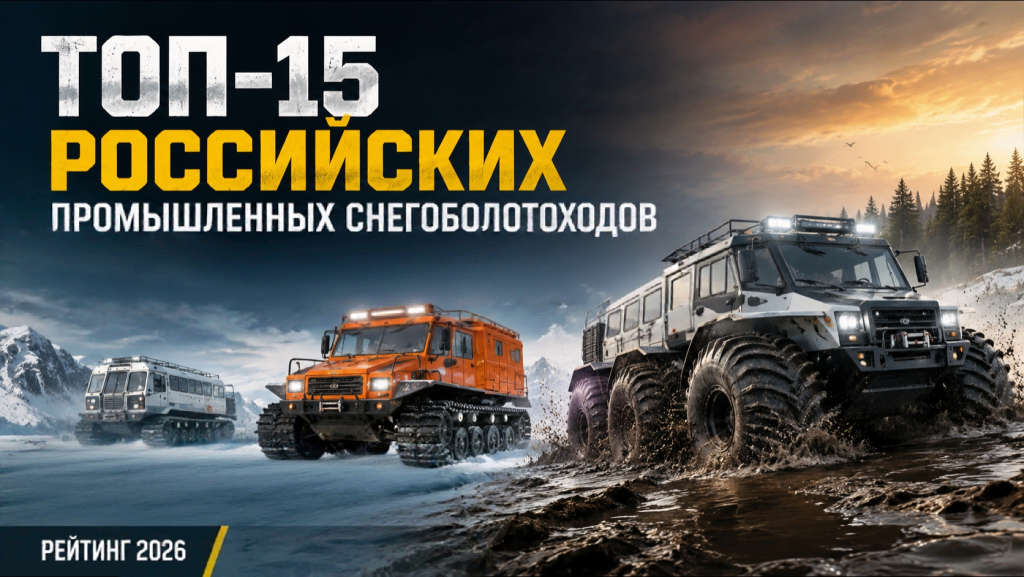
In this article, we've compiled 15 of the most significant Russian industrial all-terrain vehicles—both wheeled and tracked. The rating includes not only the most well-known models but also vehicles with real industrial applications: in the oil and gas industry, geology, energy, forestry, construction, rescue services, and the Far North.
When compiling the rating, we deliberately avoided prioritizing maximum power or payload capacity. The DT-30 can transport tens of tons, but this doesn't necessarily mean it will be the most sought-after all-terrain vehicle for most industrial enterprises. For a small geological survey team, compactness, fuel efficiency, and the ability to quickly transport personnel and equipment are far more important. For an oil and gas company, on the other hand, payload capacity, ground pressure, range, and the ability to install a drilling rig or truck-mounted crane are decisive factors.
Therefore, the rating is based on a combination of factors: equipment prevalence, industrial demand, serial production, platform versatility, payload capacity, off-road capability, maintainability, and production relevance.
We paid special attention to vehicles that are easily overlooked among more well-known brands. For example, Uzola occupies a special place in the rating as a representative of the light tracked class, and the TTM family is considered not as a single model, but as a complete line of industrial equipment—from relatively compact vehicles to heavy platforms with crane manipulators and specialized equipment.
That's why the final list was so controversial. The TM-140, Taiga, Vityaz, Ruslan, Uzola, Unzha, Burlak, and other vehicles that solve completely different problems all ended up in the same place.
The main question of the ranking isn't: "Which all-terrain vehicle is the most powerful?"
A better question is: which vehicle is best suited for a specific industrial job—and how effectively does it convert its off-road capability into payload, people, and equipment?
Key criteria:
25% — Actual prevalence and fleet size;
20% — Industrial application;
15% — Serialization and design maturity;
15% — Platform versatility;
10% — Load capacity;
5% — Off-road capability;
5% — Service, maintainability, and standardization; 5% — production relevance in 2026.
Therefore, this is not a rating of technical characteristics, but an attempt to identify the most significant Russian all-terrain vehicles for industry.
This approach allows us to compare vehicles of different classes: from the light Uzola to the super-heavy DT-30.
oil and gas;
geological exploration;
energy;
forestry;
construction;
shift crew transportation;
emergency rescue operations;
operation in the Arctic and the North;
transportation of process equipment;
installation of crane manipulators, drilling, pumping, welding, and other equipment. Not included:
Sports/tourist vehicles, homemade vehicles, and purely military platforms without normal civilian industrial applicability.
However, dual-use vehicles—for example, the Vityaz—are not excluded if the platform is objectively used or can be used in industry.
How the rating was compiled
The key point here is that "popularity" does not equal sales volume.
Russian manufacturers almost never publish comprehensive sales statistics by model. Therefore, we used a composite indicator:
Indicator: Weight
Actual prevalence/fleet — 25%
Industrial use — 20%
Serial production and design maturity — 15%
Platform versatility — 15%
Load capacity — 10%
Cross-country ability — 5%
Service/maintainability/standardization — 5%
Production relevance in 2026 — 5%
In other words, this is not a technical excellence rating.
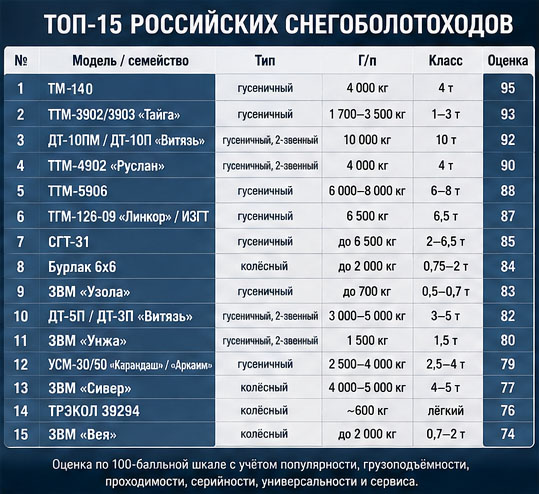
TOP 15 Russian Snow and Swamp-Going Vehicles
Rostec indicates that more than 900 TM-140s are already in operation in the northern regions. The vehicle is designed for a 4-ton payload, reaches speeds of up to 45 km/h on land and 4-5 km/h on water, and has a cruising range of over 500 km. More importantly, the platform is modular: a cargo body, a passenger module, a workshop, a crane manipulator, etc. Moreover, production is not only ongoing, but has resumed in series production, with the vehicle already being supplied to the Ministry of Emergency Situations and in operation in the Komi, Chukotka, Yakutia, and Arkhangelsk and Murmansk regions.
In 2026, Rostec separately reported more than 900 vehicles produced.
Therefore: TM-140 = the best indicator of "real industrial vehicle / fleet size / payload / relevance."
This is perhaps the most important point of the new ranking.
Are you facing the problem of separating the 3902 and 3903?
For market analysis, it is more correct to consider them as a family.
The manufacturer currently offers:
– passenger;
– cargo-passenger; - Welding;
- Drilling;
- Firefighting;
- Technical assistance vehicles.
For example, the TTM-3902GR has a 2-ton load capacity, the 3902SO has 2.5 tons, and the 3903GR has 3 tons; the 3903SO has 3.5 tons.
The 3902PS passenger vehicle has the following capacity: 14 passengers; 1.7 tons of cargo; 45 km/h; 5 km/h afloat; and a specific pressure of approximately 0.14 kgf/cm².
In other words, the Taiga is not a single vehicle, but an entire industrial platform.
That's why we prioritize this family over individual, more powerful all-terrain vehicles.
The DT-10P has: a 10-ton load capacity; a two-link design; buoyancy; approximately 45 km/h on land; up to 5 km/h on water; and a specific pressure of approximately 0.22 kgf/cm².
And most importantly, the two-link design allows it to operate in areas where conventional wheeled vehicles and most single-hull tracked vehicles become ineffective.
Why not #1? — Because for most industrial companies:
4 tons is a useful working class;
10 tons is a specialized heavy vehicle.
NPO "Transport" currently offers:
4902GR — 4 tons;
4902GM — 4 t + crane;
4902GP — 3.5 t + hydraulic lift;
4902TZ — fuel tanker;
4902BK — drilling and crane rig;
roadside assistance and other options.
This is a very strong argument for its industrial popularity.
The Ruslan is more than just a transport vehicle. It's a carrier of technological equipment.
cargo-passenger — 6 t;
passenger — 6 t with 20 passengers;
some versions reach up to 8 t.
In essence, this is a very interesting "workhorse" between the TTM-49 and the heavy DT-10.
IZGT manufactures civilian vehicles based on a seven-roller tracked platform. The TGM-126-09 is claimed to have a payload capacity of:
up to 6.5 tons. This isn't just a catalog figure: the vehicle is actually included in geological organizations' procurement plans for 2026. For example, the All-Russian Research Geological Institute's procurement list includes the TGM-126-09 and TG-126-06.
And the new TGM-126-09 with a URB is being offered specifically as a mobile drilling rig.
For geology, this is one of the most interesting vehicles in the ranking.
The reason is simple: it's very old in concept, but proven.
It's been in production for about 20 years, and there are cargo, passenger, forest firefighting, and other versions.
This is precisely the case when:
"Design novelty" ≠ "value for the industrial customer."
If a company has been operating an SGT-31 for ten years, knows how to maintain it, and has spare parts, replacing it with a "more modern" vehicle isn't always economically feasible.
In July 2026, the manufacturer explicitly stated that the Uzola platform is already in use:
in the oil and gas industry;
geological exploration;
energy;
forestry;
environmental protection organizations;
hunting farms;
expeditions.
That is, it is not just a “good all-terrain vehicle”
. Professional operation has been confirmed.
The ZVM-2411 "Uzola" currently has the following characteristics: weight - up to 4 tons; load capacity - 700 kg; 2-7 seats; ground pressure - 15-19 kPa; speed - up to 50 km/h; floating speed - 4-5 km/h; ground clearance - 400 mm.
There are modifications: 2411G - cargo, 2411GP - cargo-passenger, 2411P - passenger.
There is a ZMZ-PRO gasoline engine and a Cummins 2.8 diesel engine.
What about the 2413? - It has a 620 mm wide belt track and a ground pressure of approximately 14 kPa, with a load capacity of 500 kg.
This is precisely why the "Uzola" is a very good representative of the light industrial tracked vehicle class.
According to published specifications:
DT-3P / DT-5P
Load capacity: 3 t / 5 t
Weight: 7.3 t / 12 t
Speed: up to 50 km/h / up to 40 km/h
Afloat: up to 5 km/h / up to 5 km/h
Pressure: 0.16 / 0.22 kgf/cm²
This is an excellent class for those who find the 10-ton DT-10 too much, but need a true two-link vehicle.
The "Unzha" is a two-link amphibious tracked all-terrain vehicle. Moreover, both links are active.
Load capacity: 1.5 tons, of which 500 kg is for the first link and 1,000 kg for the second.
Weight is only about 4.3 tons.
This results in an extremely interesting ratio: 4.3 tons of tare weight → 1.5 tons of payload.
For a light two-link class, this is a very good figure.
And this is precisely the machine that can be considered a "mini-DT-10" for small industrial crews.
USM-10 "Egoza" - 1.5 tons;
USM-30 "Karandash" - 2.5 tons;
USM-40 "Argus" - 2.5 tons;
USM-50 "Arkaim" — 4 tons;
USM-60 "Taganay" — 4 tons.
For example, the USM-30 has a gross vehicle weight of 12.5 tons; a payload capacity of 2.5 tons; a top speed of up to 61.5 km/h; afloat speed of up to 6 km/h; and a cruising range of approximately 500 km.
This makes it a fully-fledged civilian industrial alternative to some older MT-LB derivatives.
And the stated payload capacity is 4 tons for the 4x4 and up to 5 tons for the 6x6.
Take note.
If you don't need the Burlak's level of buoyancy, but need:
diesel;
a cargo platform;
high load capacity;
wheeled chassis;
high maintainability;
the ability to use truck components,
then the Siver may prove more efficient than most "pure" all-terrain vehicles.
TREKOL is extremely well-known and widespread, but its load capacity and technological equipment capabilities are significantly lower than those of the TM-140, TTM, SGT, etc.
Therefore: high popularity → average industrial performance.
The 6x6 in the current lineup is claimed to have a payload capacity of up to 1.5–2 tons depending on the version, up to 10–12 seats, and a ground clearance of 600–700 mm.
However, some older "Veya" models have already been discontinued, which is taken into account by a negative coefficient. Therefore, the "Veya" is no taller than the "Siver."
Where does the DT-30 end up now?
And here's an interesting result.
We don't put the DT-30 in the top five.
Although, in terms of technical capabilities, it is certainly one of the leaders.
DT-30PM-1: payload capacity — 30 tons; weight — about 29 tons; engine — 710 hp; Land speed: up to 37 km/h; afloat: up to 5 km/h; operating at -50 to +40°C.
The Vityaz family ranges from the DT-3P to the DT-30, with a payload capacity of 3–30 tons.
However:
The DT-30 is the best super-heavy all-terrain vehicle, but not the most popular industrial snow and swamp vehicle.
Its proper place is in a separate class.
From all of the above, it follows that we need to create not just one rating, but the following market structure:
Light class: up to ~1 ton
1. Uzola
2. TREKOL
3. Veya
The key here is mobility + minimal pressure + small crew.
Medium wheeled — 1–5 t
1. Siver
2. Burlak
3. Veya
4. RUSAK
The key factors are: load + speed + maintainability + the ability to use vehicle components.
All-terrain vehicle market structure - 2026. Russia
Medium tracked — 1.5–4 t
TTM-3902/3903
Unzha
USM-30/40/50
TM-140
This is where the main market for industrial all-terrain vehicles is located:
Heavy — 4–10 t
TTM-4902
TTM-5906
TGM-126-09
SGT-31
DT-10
Here, the vehicle becomes a carrier of technological equipment:
Super-heavy
DT-30
And this is a league of its own.
Conclusion - the main conclusion
The Russian market can be summarized as follows:
The absolute leader in real mass industrial use is the TM-140.
A fleet of over 900 machines and ongoing serial production make it a very strong candidate for first place.
The most mature industrial platform is the TTM family.
And not just one model, but an entire line:
390 → 490 → 590 → 690.
The manufacturer
Currently, there are vehicles from ~1 to 8.5 tons, including specialized versions with drilling rigs, cranes, welding, pumping, and other equipment.
The best heavy-duty vehicle is the DT-10.
10 tons and a two-link design is an extremely powerful combination.
The most interesting is the small two-link Unzha.
Because it offers a two-link design with only 1.5 tons of payload capacity.
The most underrated light industrial vehicle is the Uzola.
The most interesting wheeled industrial vehicle is the Burlak/Siver, but these are two completely different philosophies.
The Burlak is a true amphibious all-terrain vehicle. Its 6x6 wheels are rated for 2 tons on hard ground, 750 kg on soft ground/on water, and a pressure of 0.18 kgf/cm².
The Siver is much closer to a heavy-duty truck with extreme off-road capability: up to 5 tons for the 6x6 wheels.
Key leaders in the all-terrain vehicle market in Russia
And one more important thing
If your ultimate goal is not just to compile a rating, but to understand which vehicle is the most cost-effective to buy for industrial use, then the current rating is not enough.
All-terrain vehicle rating in Russia - 2026
The next level of analysis is as follows:
15 vehicles × 25 parameters, including:
Price of a new vehicle;
Price of a used vehicle;
Loading capacity;
Loading capacity on soft ground;
Ground pressure;
Fuel consumption;
Cruising range;
Speed;
Floating speed;
Floatability;
Snow depth;
Permissible slope;
Capacity;
Cargo platform volume;
Engine;
Power;
Specific power;
Resource;
Maintenance cost;
Spare parts availability;
Track/tire cost;
Maintainability;
KMU capability;
Drilling capability;
Habitation module capability.
And then you can get not just a subjective TOP-15, but a matrix of "cost of ownership → ton of cargo → kilometer → cross-country capability."
For oil and gas and geological exploration, this will be much more useful than a simple ranking.
Read our next ANALYSIS in August – stay tuned for new publications on the ZVM website on the ZVM | Media channel.
Prepared by the Digital Communications Department of All-Terrain Vehicle Plant LLC
For inquiries regarding the use of materials:
digital@zvm-nn.ru | © 2026
All-Terrain Vehicle Rating in Russia - 2026
24 August 2026
Russian Snow and Swamp-Going Vehicles: Top 15 Industrial Machines for the North, Swamps, and Off-Road
From the Uzola to the DT-30: Which Russian all-terrain vehicles are truly in demand in industry andHow wheeled vehicles differ from heavy tracked platforms.
The Russian all-terrain vehicle market is much more diverse
than it might seem. There are compact vehicles for geologists and emergency crews, wheeled amphibious vehicles for working in swamps, heavy tracked platforms for the oil and gas industry, and two-section transporters capable of carrying several tons of cargo in places where conventional vehicles simply cannot.In this article, we've compiled 15 of the most significant Russian industrial all-terrain vehicles—both wheeled and tracked. The rating includes not only the most well-known models but also vehicles with real industrial applications: in the oil and gas industry, geology, energy, forestry, construction, rescue services, and the Far North.
When compiling the rating, we deliberately avoided prioritizing maximum power or payload capacity. The DT-30 can transport tens of tons, but this doesn't necessarily mean it will be the most sought-after all-terrain vehicle for most industrial enterprises. For a small geological survey team, compactness, fuel efficiency, and the ability to quickly transport personnel and equipment are far more important. For an oil and gas company, on the other hand, payload capacity, ground pressure, range, and the ability to install a drilling rig or truck-mounted crane are decisive factors.
Therefore, the rating is based on a combination of factors: equipment prevalence, industrial demand, serial production, platform versatility, payload capacity, off-road capability, maintainability, and production relevance.
We paid special attention to vehicles that are easily overlooked among more well-known brands. For example, Uzola occupies a special place in the rating as a representative of the light tracked class, and the TTM family is considered not as a single model, but as a complete line of industrial equipment—from relatively compact vehicles to heavy platforms with crane manipulators and specialized equipment.
That's why the final list was so controversial. The TM-140, Taiga, Vityaz, Ruslan, Uzola, Unzha, Burlak, and other vehicles that solve completely different problems all ended up in the same place.
The main question of the ranking isn't: "Which all-terrain vehicle is the most powerful?"
A better question is: which vehicle is best suited for a specific industrial job—and how effectively does it convert its off-road capability into payload, people, and equipment?
How the ranking was compiled
For the assessment, we used a composite score on a 100-point scale.Key criteria:
25% — Actual prevalence and fleet size;
20% — Industrial application;
15% — Serialization and design maturity;
15% — Platform versatility;
10% — Load capacity;
5% — Off-road capability;
5% — Service, maintainability, and standardization; 5% — production relevance in 2026.
Therefore, this is not a rating of technical characteristics, but an attempt to identify the most significant Russian all-terrain vehicles for industry.
This approach allows us to compare vehicles of different classes: from the light Uzola to the super-heavy DT-30.
TOP 15 Russian Industrial All-Terrain Vehicles Rating as of August 2026.
What exactly are we counting?
An "industrial all-terrain vehicle" is defined as a vehicle designed for or actually used for:oil and gas;
geological exploration;
energy;
forestry;
construction;
shift crew transportation;
emergency rescue operations;
operation in the Arctic and the North;
transportation of process equipment;
installation of crane manipulators, drilling, pumping, welding, and other equipment. Not included:
Sports/tourist vehicles, homemade vehicles, and purely military platforms without normal civilian industrial applicability.
However, dual-use vehicles—for example, the Vityaz—are not excluded if the platform is objectively used or can be used in industry.
How the rating was compiled
The key point here is that "popularity" does not equal sales volume.
Russian manufacturers almost never publish comprehensive sales statistics by model. Therefore, we used a composite indicator:
Indicator: Weight
Actual prevalence/fleet — 25%
Industrial use — 20%
Serial production and design maturity — 15%
Platform versatility — 15%
Load capacity — 10%
Cross-country ability — 5%
Service/maintainability/standardization — 5%
Production relevance in 2026 — 5%
In other words, this is not a technical excellence rating.
TOP 15 Russian Snow and Swamp-Going Vehicles
TOP 15
| № | Machine/Family | Type | Class | Load capacity, kg | Popularity | Grade |
|---|---|---|---|---|---|---|
| 1 | ТМ-140 | tracked | amphibious | 4 000 | ★★★★★ | 95 |
| 2 | ТТМ-3902/3903 «Тайга» / «Taiga» | tracked | amphibious | 1 700–3 500 | ★★★★★ | 93 |
| 3 | ДТ-10ПМ / ДТ-10П «Витязь» / «Vityaz» | 2-link tracked | – | 10 000 | ★★★★★ | 92 |
| 4 | ТТТМ-4902 «Руслан» / «Ruslan» | 2-link tracked | – | 4 000 | ★★★★☆ | 90 |
| 5 | ТТМ-5906 | tracked | amphibious | 6 000–8 000 | ★★★★☆ | 88 |
| 6 | ТГМ-126-09 «Линкор» (ИЗГТ) / «Linkor» (IZGT) | tracked | – | 6 500 | ★★★★☆ | 87 |
| 7 | СГТ-31 | tracked | – | до 6 500 | ★★★★ | 85 |
| 8 | Бурлак 6×6 / Burlak 6×6 | wheeled | amphibious | до 2 000 | ★★★★ | 84 |
| 9 | ЗВМ-2411 «Узола» / ZVM-2411 Uzola | tracked | amphibious | до 700 | ★★★★ | 83 |
| 10 | ДТ-5П / ДТ-3П «Витязь» / «Vityaz» | 2-link tracked | – | 3 000–5 000 | ★★★★ | 82 |
| 11 | ЗВМ «Унжа» / ZVM Unzha | 2-link tracked | – | 1 500 | ★★★☆ | 80 |
| 12 | УСМ-30/50 «Карандаш» / «Аркаим» // «Karandash» / «Arkaim» | tracked | – | 2 500–4 000 | ★★★☆ | 79 |
| 13 | ЗВМ «Сивер» / ZVM «Siver» | wheeled 4×4, 6×6 | – | 4 000–5 000 | ★★★☆ | 77 |
| 14 | ТРЭКОЛ 39294 / TREKOL 39294 | wheeled 6×6 | amphibious | ~600 | ★★★★ | 76 |
| 15 | ЗВМ «Вея» / ZVM «Veya» | wheeled 4×4, 6×6 | amphibious | до 2 000 | ★★★☆ | 74 |
Answering the question "Why?"
Why the TM-140 is #1
For the industrial market, the TM-140 currently appears to be one of the most well-balanced Russian vehicles overall.Rostec indicates that more than 900 TM-140s are already in operation in the northern regions. The vehicle is designed for a 4-ton payload, reaches speeds of up to 45 km/h on land and 4-5 km/h on water, and has a cruising range of over 500 km. More importantly, the platform is modular: a cargo body, a passenger module, a workshop, a crane manipulator, etc. Moreover, production is not only ongoing, but has resumed in series production, with the vehicle already being supplied to the Ministry of Emergency Situations and in operation in the Komi, Chukotka, Yakutia, and Arkhangelsk and Murmansk regions.
In 2026, Rostec separately reported more than 900 vehicles produced.
Therefore: TM-140 = the best indicator of "real industrial vehicle / fleet size / payload / relevance."
Why is the TTM-3902/3903 "Taiga" #2?
This is perhaps the most important point of the new ranking.
Are you facing the problem of separating the 3902 and 3903?
For market analysis, it is more correct to consider them as a family.
The manufacturer currently offers:
– passenger;
– cargo-passenger; - Welding;
- Drilling;
- Firefighting;
- Technical assistance vehicles.
For example, the TTM-3902GR has a 2-ton load capacity, the 3902SO has 2.5 tons, and the 3903GR has 3 tons; the 3903SO has 3.5 tons.
The 3902PS passenger vehicle has the following capacity: 14 passengers; 1.7 tons of cargo; 45 km/h; 5 km/h afloat; and a specific pressure of approximately 0.14 kgf/cm².
In other words, the Taiga is not a single vehicle, but an entire industrial platform.
That's why we prioritize this family over individual, more powerful all-terrain vehicles.
No. 3 - Vityaz DT-10
Here the heavy-duty class begins.The DT-10P has: a 10-ton load capacity; a two-link design; buoyancy; approximately 45 km/h on land; up to 5 km/h on water; and a specific pressure of approximately 0.22 kgf/cm².
And most importantly, the two-link design allows it to operate in areas where conventional wheeled vehicles and most single-hull tracked vehicles become ineffective.
Why not #1? — Because for most industrial companies:
4 tons is a useful working class;
10 tons is a specialized heavy vehicle.
#4 — TTM-4902 "Ruslan"
We rank this vehicle above the "Burlak" — Why? Because the "Ruslan" is a truly industrial two-link platform.NPO "Transport" currently offers:
4902GR — 4 tons;
4902GM — 4 t + crane;
4902GP — 3.5 t + hydraulic lift;
4902TZ — fuel tanker;
4902BK — drilling and crane rig;
roadside assistance and other options.
This is a very strong argument for its industrial popularity.
The Ruslan is more than just a transport vehicle. It's a carrier of technological equipment.
No. 5 — TTM-5906
Now NPO Transport is presenting the 59 family as a separate industrial class:cargo-passenger — 6 t;
passenger — 6 t with 20 passengers;
some versions reach up to 8 t.
In essence, this is a very interesting "workhorse" between the TTM-49 and the heavy DT-10.
No. 6 — TGM-126-09 "Linkor"
This is perhaps the most underrated vehicle.IZGT manufactures civilian vehicles based on a seven-roller tracked platform. The TGM-126-09 is claimed to have a payload capacity of:
up to 6.5 tons. This isn't just a catalog figure: the vehicle is actually included in geological organizations' procurement plans for 2026. For example, the All-Russian Research Geological Institute's procurement list includes the TGM-126-09 and TG-126-06.
And the new TGM-126-09 with a URB is being offered specifically as a mobile drilling rig.
For geology, this is one of the most interesting vehicles in the ranking.
No. 7 — SGT-31
The SGT-31 made it into the top ten, but the TGM-126 is now one step below.The reason is simple: it's very old in concept, but proven.
It's been in production for about 20 years, and there are cargo, passenger, forest firefighting, and other versions.
This is precisely the case when:
"Design novelty" ≠ "value for the industrial customer."
If a company has been operating an SGT-31 for ten years, knows how to maintain it, and has spare parts, replacing it with a "more modern" vehicle isn't always economically feasible.
No. 9 — "UZOLA"
The lightweight UZOLA should be in the main ranking.In July 2026, the manufacturer explicitly stated that the Uzola platform is already in use:
in the oil and gas industry;
geological exploration;
energy;
forestry;
environmental protection organizations;
hunting farms;
expeditions.
That is, it is not just a “good all-terrain vehicle”
. Professional operation has been confirmed.
The ZVM-2411 "Uzola" currently has the following characteristics: weight - up to 4 tons; load capacity - 700 kg; 2-7 seats; ground pressure - 15-19 kPa; speed - up to 50 km/h; floating speed - 4-5 km/h; ground clearance - 400 mm.
There are modifications: 2411G - cargo, 2411GP - cargo-passenger, 2411P - passenger.
There is a ZMZ-PRO gasoline engine and a Cummins 2.8 diesel engine.
What about the 2413? - It has a 620 mm wide belt track and a ground pressure of approximately 14 kPa, with a load capacity of 500 kg.
This is precisely why the "Uzola" is a very good representative of the light industrial tracked vehicle class.
No. 10 — DT-5P / DT-3P
This is the small Vityaz.According to published specifications:
DT-3P / DT-5P
Load capacity: 3 t / 5 t
Weight: 7.3 t / 12 t
Speed: up to 50 km/h / up to 40 km/h
Afloat: up to 5 km/h / up to 5 km/h
Pressure: 0.16 / 0.22 kgf/cm²
This is an excellent class for those who find the 10-ton DT-10 too much, but need a true two-link vehicle.
No. 11 — ZVM "UNZHA"
And this is the second ZVM family that should definitely be included in the ranking.The "Unzha" is a two-link amphibious tracked all-terrain vehicle. Moreover, both links are active.
Load capacity: 1.5 tons, of which 500 kg is for the first link and 1,000 kg for the second.
Weight is only about 4.3 tons.
This results in an extremely interesting ratio: 4.3 tons of tare weight → 1.5 tons of payload.
For a light two-link class, this is a very good figure.
And this is precisely the machine that can be considered a "mini-DT-10" for small industrial crews.
No. 12 — USM
Here, too, the rating is expanding not just with one model, but with a family. Uralspetsmash currently has:USM-10 "Egoza" - 1.5 tons;
USM-30 "Karandash" - 2.5 tons;
USM-40 "Argus" - 2.5 tons;
USM-50 "Arkaim" — 4 tons;
USM-60 "Taganay" — 4 tons.
For example, the USM-30 has a gross vehicle weight of 12.5 tons; a payload capacity of 2.5 tons; a top speed of up to 61.5 km/h; afloat speed of up to 6 km/h; and a cruising range of approximately 500 km.
This makes it a fully-fledged civilian industrial alternative to some older MT-LB derivatives.
No. 13 — ZVM "Siver"
And this, in our opinion, is the most underrated wheeled industrial class. Why? Because the "Siver" isn't built as a toy all-terrain vehicle, but on the GAZ-33081 "Sadko" chassis with portal axles.And the stated payload capacity is 4 tons for the 4x4 and up to 5 tons for the 6x6.
Take note.
If you don't need the Burlak's level of buoyancy, but need:
diesel;
a cargo platform;
high load capacity;
wheeled chassis;
high maintainability;
the ability to use truck components,
then the Siver may prove more efficient than most "pure" all-terrain vehicles.
No. 14 — TREKOL
TREKOL is in the ranking, but in a very low position. The reason is that we are currently evaluating industrial applications.TREKOL is extremely well-known and widespread, but its load capacity and technological equipment capabilities are significantly lower than those of the TM-140, TTM, SGT, etc.
Therefore: high popularity → average industrial performance.
No. 15 — ZVM "Veya"
And here, too, there's an important caveat: the "Veya" has 4x4 and 6x6 models, different tires, and several generations.The 6x6 in the current lineup is claimed to have a payload capacity of up to 1.5–2 tons depending on the version, up to 10–12 seats, and a ground clearance of 600–700 mm.
However, some older "Veya" models have already been discontinued, which is taken into account by a negative coefficient. Therefore, the "Veya" is no taller than the "Siver."
Where does the DT-30 end up now?
And here's an interesting result.
We don't put the DT-30 in the top five.
Although, in terms of technical capabilities, it is certainly one of the leaders.
DT-30PM-1: payload capacity — 30 tons; weight — about 29 tons; engine — 710 hp; Land speed: up to 37 km/h; afloat: up to 5 km/h; operating at -50 to +40°C.
The Vityaz family ranges from the DT-3P to the DT-30, with a payload capacity of 3–30 tons.
However:
The DT-30 is the best super-heavy all-terrain vehicle, but not the most popular industrial snow and swamp vehicle.
Its proper place is in a separate class.
From all of the above, it follows that we need to create not just one rating, but the following market structure:
Light class: up to ~1 ton
1. Uzola
2. TREKOL
3. Veya
The key here is mobility + minimal pressure + small crew.
Medium wheeled — 1–5 t
1. Siver
2. Burlak
3. Veya
4. RUSAK
The key factors are: load + speed + maintainability + the ability to use vehicle components.
All-terrain vehicle market structure - 2026. Russia
Medium tracked — 1.5–4 t
TTM-3902/3903
Unzha
USM-30/40/50
TM-140
This is where the main market for industrial all-terrain vehicles is located:
Heavy — 4–10 t
TTM-4902
TTM-5906
TGM-126-09
SGT-31
DT-10
Here, the vehicle becomes a carrier of technological equipment:
Super-heavy
DT-30
And this is a league of its own.
Conclusion - the main conclusion
The Russian market can be summarized as follows:
The absolute leader in real mass industrial use is the TM-140.
A fleet of over 900 machines and ongoing serial production make it a very strong candidate for first place.
The most mature industrial platform is the TTM family.
And not just one model, but an entire line:
390 → 490 → 590 → 690.
The manufacturer
Currently, there are vehicles from ~1 to 8.5 tons, including specialized versions with drilling rigs, cranes, welding, pumping, and other equipment.
The best heavy-duty vehicle is the DT-10.
10 tons and a two-link design is an extremely powerful combination.
The most interesting is the small two-link Unzha.
Because it offers a two-link design with only 1.5 tons of payload capacity.
The most underrated light industrial vehicle is the Uzola.
The most interesting wheeled industrial vehicle is the Burlak/Siver, but these are two completely different philosophies.
The Burlak is a true amphibious all-terrain vehicle. Its 6x6 wheels are rated for 2 tons on hard ground, 750 kg on soft ground/on water, and a pressure of 0.18 kgf/cm².
The Siver is much closer to a heavy-duty truck with extreme off-road capability: up to 5 tons for the 6x6 wheels.
Key leaders in the all-terrain vehicle market in Russia
And one more important thing
If your ultimate goal is not just to compile a rating, but to understand which vehicle is the most cost-effective to buy for industrial use, then the current rating is not enough.
All-terrain vehicle rating in Russia - 2026
The next level of analysis is as follows:
15 vehicles × 25 parameters, including:
Price of a new vehicle;
Price of a used vehicle;
Loading capacity;
Loading capacity on soft ground;
Ground pressure;
Fuel consumption;
Cruising range;
Speed;
Floating speed;
Floatability;
Snow depth;
Permissible slope;
Capacity;
Cargo platform volume;
Engine;
Power;
Specific power;
Resource;
Maintenance cost;
Spare parts availability;
Track/tire cost;
Maintainability;
KMU capability;
Drilling capability;
Habitation module capability.
And then you can get not just a subjective TOP-15, but a matrix of "cost of ownership → ton of cargo → kilometer → cross-country capability."
For oil and gas and geological exploration, this will be much more useful than a simple ranking.
Read our next ANALYSIS in August – stay tuned for new publications on the ZVM website on the ZVM | Media channel.
Prepared by the Digital Communications Department of All-Terrain Vehicle Plant LLC
For inquiries regarding the use of materials:
digital@zvm-nn.ru | © 2026
All-Terrain Vehicle Rating in Russia - 2026